

 6 months ago
78
6 months ago
78
PROTECT YOUR DNA WITH QUANTUM TECHNOLOGY
Orgo-Life the new way to the future Advertising by AdpathwayNovember 20, 2025
Today, with our sixth presenter — former Congressman Ron Paul, who now heads the Ron Paul Institute — we wrap up our special series of our weekly Internet show The Libertarian Angle — a series whose theme is “The Critical Importance of Civil Liberties.”
All six presentations, most of which have been co-hosted by Richard Ebeling and me, can be accessed in the multimedia section of FFF’s website. Our six presenters are all gigantic defenders of civil liberties: Jim Bovard, Radley Balko, John Whitehead, Michael Glennon, Andrew Napolitano, and Ron Paul.
Why this series? The answer is very simple: Civil liberties are essential prerequisites for a genuinely free society. As important as economic liberty is — as important as a non-interventionist foreign policy is — as important as restoring a limited-government republic is — as important as ending the drug war is — as important as educational liberty is — as important as free trade and open immigration are — as important as sound money is — and as important as gun rights are — they simply are not enough. To achieve a genuinely free society, is imperative that we restore civil liberties to our land.
If a survey were to be taken of libertarians, I think that most would respond that their first exposure to libertarianism took place with the discovery of the principles of economic liberty, including what is known as Austrian economics — or free-market economics. That certainly is what happened to me. When I was a young lawyer in my late 20s, I walked into the public library of my hometown of Laredo, Texas, looking for something to read. I came across four little books entitled Essays on Liberty, volumes 1-4, and began perusing them. They were hard-core, no-compromise essays on economic aspects of the libertarian philosophy that had been published by The Foundation for Economic Education some 2o years before. The truth contained in those essays shattered the inches-thick indoctrination that encased my mind as a result of 12 years of public (i.e., government) schooling. Those books ended up changing the course of my life. They ultimately served as the foundation for our methodology here at FFF for advancing liberty — presenting the principled, uncompromising case for all aspects of libertarianism.
Yet, prior to my discovery of libertarianism, I had been exposed to the critical importance of civil liberties.
It goes without saying, of course, that civil liberties were emphasized in my courses in law school at the University of Texas.
But even before that, as a kid growing up in a border town, I had experienced the concept of civil liberties in the context of the immigration police state that has long characterized America’s borderlands. Americans who are today experiencing the heavy hand of the federal government as it enforces America’s socialist immigration-control system in other parts of the country are seeing the type of things that I saw some 60 years ago growing up in Laredo.
Of course, as a kid I didn’t know anything about civil liberties. But I just instinctively knew that something wasn’t right when our family was required to stop at an immigration checkpoint 40 miles north of Laredo whenever we were traveling to San Antonio.
I also knew something wasn’t right when some disgruntled housewife would snitch on some other housewife by reporting her illegal maid or nanny to federal immigration officials, who would quickly go visit that home and bust and deport the maid or nanny.
I also knew something was wrong when, as a high school student, I got stopped for no reason by a Border Patrol agent when I was driving to the beach and was then forced to submit my vehicle to a warrantless search.
I also instinctively knew that something was fundamentally wrong when Border Patrol agents would trespass onto our farm on the Rio Grande, where we lived, without a search warrant and bust and deport our workers who weren’t harming anyone.
Moreover, the 1960s was when the feds were launching in Laredo and elsewhere what would become the decades-long, ongoing, never-ending, perpetual deadly and destructive drug-war racket. I had friends in high school who were busted for bringing small quantities of marijuana back from Nuevo Laredo and having their lives essentially ruined with a federal drug conviction. In fact, my very first trial as a lawyer was a drug case in federal district court, a case where the DEA had set up my client, who was indigent, on a bogus drug charge. The jury acquitted him.
When I returned to Laredo to practice law, I made an appointment to see our local federal judge. I asked him to appoint me to represent illegal immigrants for free. I told him that I wished to challenge the constitutionality of the arbitrary and capricious way that the immigration-control statutes were being enforced. He agreed to do so.
I also joined the American Civil Liberties Union because I was deeply impressed with their defense of Nazi protestors in Skokie, Illinois, on the ground that the right of freedom of speech entails the protection of the most despicable speech, not the most popular or most acceptable speech. I later became the ACLU representative in Laredo.
All this was before I discovered those four little books on libertarian economic principles in the Laredo public library that ended up changing the course of my life.

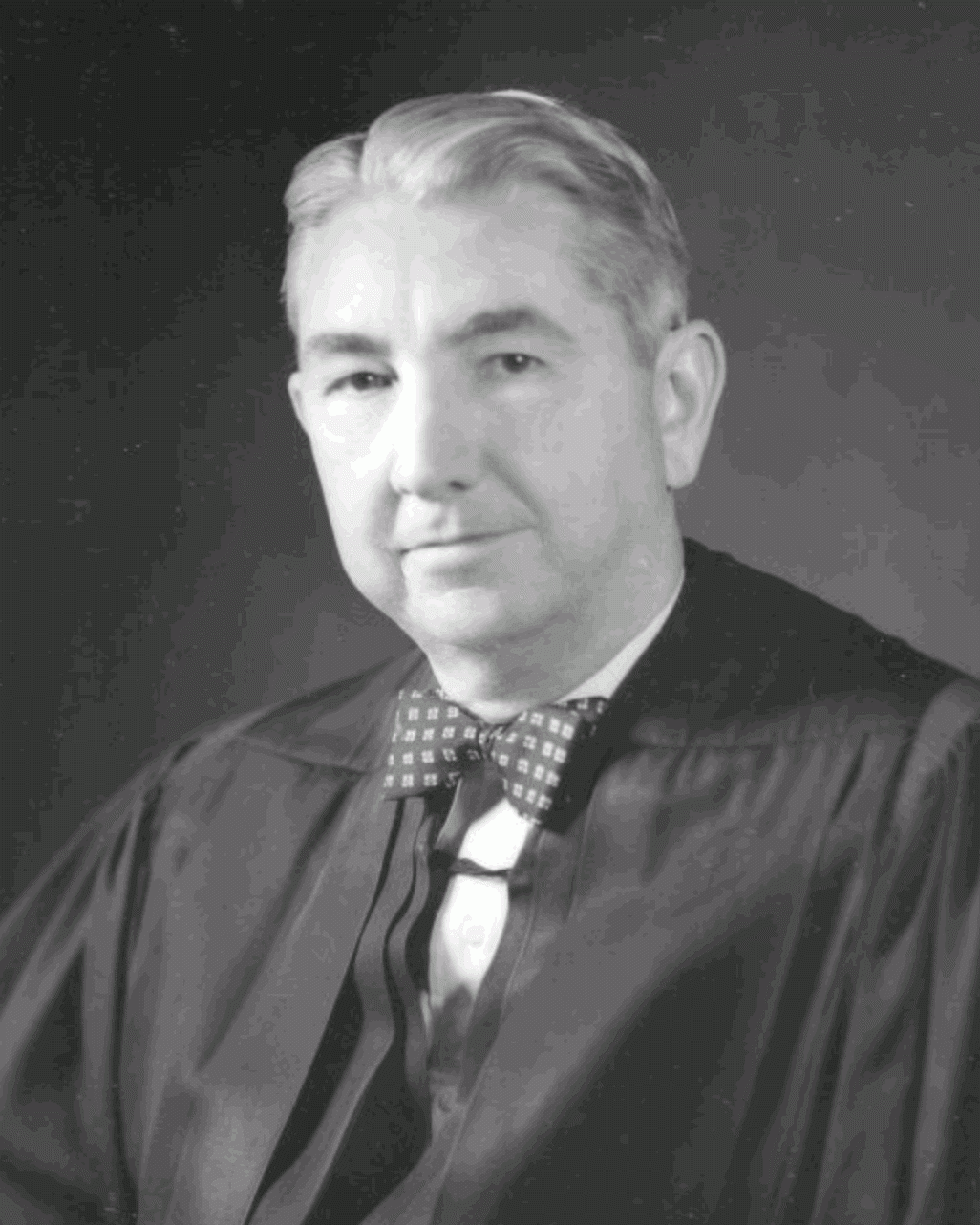
Hugo L. Black
In the first year after I founded The Future of Freedom Foundation in 1989, we published an essay on civil liberties entitled “The Bill of Rights” by Justice Hugo L. Black. I wish every American living today would read it. Black wrote in part:
“Today most Americans seem to have forgotten the ancient evils which forced their ancestors to flee to this new country and to form a government stripped of old powers used to oppress them. But the Americans who supported the Revolution and the adoption of our Constitution knew firsthand the dangers of tyrannical governments. They were familiar with the long existing practice of English persecutions of people wholly because of their religious or political beliefs. They knew that many accused of such offenses had stood, helpless to defend themselves, before biased legislators and judges…. I cannot agree with those who think of the Bill of Rights as an 18th Century straitjacket, unsuited for this age. It is old but not all old things are bad. The evils it guards against are not only old, they are with us now, they exist today.”
Ever since our founding, FFF has emphasized the critical importance of civil liberties with our essays, speeches, conferences, and books. We shall continue doing so. The reason is simple: We want to live in a genuinely free society, and civil liberties are a critically important prerequisite for achieving that goal.










.png)






.jpg)



 English (US) ·
  French (CA) ·