

.png) 4 weeks ago
22
PROTECT YOUR DNA WITH QUANTUM TECHNOLOGY
Orgo-Life the new way to the future Advertising by AdpathwayPresident Donald Trump veered into a monologue about his aspirin regimen while speaking at an event in Vandalia, Ohio, on Saturday.
“I take an aspirin a day. I don’t know if it works, but psychologically, I need it. It thins the hell out of your blood, I guess,” Trump told the crowd. “I don’t know if it works or not, but I’ve been doing it for a long time. And here I am making speeches.”
He went on to explain his dosing preferences.
“I like Bayer aspirin. And I take the big one. They want me to go down to the 80. I take the 386. I don’t know what the hell it is. It’s a monster,” he said. “They said, ‘Sir, you don’t need that!’ I said, do me a favor, I’ve been doing okay for 35 years. Leave me alone.”
Trump: "I take an aspirin a day. I don't know if it works but psychologically I need it. It thins the hell out of your blood I guess. I don't know if it works or not but I've been doing it for a long time. And here I am making speeches. I like Bayer aspirin. And I take the big… pic.twitter.com/bDh8eni5Nl
— Aaron Rupar (@atrupar) October 4, 2026The aspirin tangent eventually led Trump to his point ― congratulating Bayer, which recently announced it will build a $2.2 billion manufacturing plant near Columbus.
Trump’s actual aspirin dose is 325 milligrams, according to his physician, Dr. Sean Barbabella, who confirmed to The Wall Street Journal in a January article that the president takes it daily for “cardiac prevention.” In that interview, Trump acknowledged that his doctors want him on the lower 81-milligram dose but said he’s “a little superstitious.” He also shared more of his reasoning.
“They say aspirin is good for thinning out the blood, and I don’t want thick blood pouring through my heart,” he told the paper. “I want nice, thin blood pouring through my heart. Does that make sense?”
Not exactly, according to doctors. As medical analyst Dr. Jonathan Reiner said on CNN at the time, aspirin doesn’t literally thin the blood.
“It’s not like changing something from gumbo to chicken soup,” he said. “It doesn’t make it thinner. It makes you less likely to clot.”
Dr. William Lawson, director of preventive cardiology at the Stony Brook Heart and Vascular Institute, explained to HuffPost that “aspirin works by decreasing platelet function and clot formation,” which is an initial event in many cardiovascular events like heart attacks and strokes.
Trump is hardly the only American with a daily aspirin habit. But experts say the guidance around it has shifted significantly in recent years.
“It is common for people to take aspirin, but the recommendations are different today than they were a decade ago because of a number of important clinical trials published around 2018 that did not show a benefit for most people,” Dr. Gregory Katz, a cardiologist at NYU Langone Heart, told HuffPost.
Here’s what doctors want people to know.
What Doctors Say About Daily Aspirin
“Aspirin slightly lowers the risk of heart attack and stroke and comes at a slightly increased risk of bleeding complications,” Katz explained. “For most people who have never had a heart attack or stroke, aspirin does not seem to have much benefit.”
The doctors who spoke to HuffPost drew a key distinction between two groups of patients.
“Taking a low-dose aspirin 81 mg daily is essential for what we call secondary prevention, meaning a disease process is already diagnosed, and we are trying to prevent it from progressing,” said Dr. Amit Blumfield, a cardiologist with Manhattan Cardiology and a contributor to the healthcare platform LabFinder. “Most often this is for coronary artery disease (CAD), peripheral artery disease (PAD) or prior stroke. Aspirin for primary prevention, meaning no diagnosed CAD, PAD or prior stroke, is a more debated topic.”
So low-dose aspirin is often prescribed to patients with established cardiovascular issues such as those who have had a heart attack, coronary stent, bypass surgery, etc.
“It is also commonly prescribed to younger patients, 40-59 years, at high risk of a cardiovascular event,” Lawson noted.
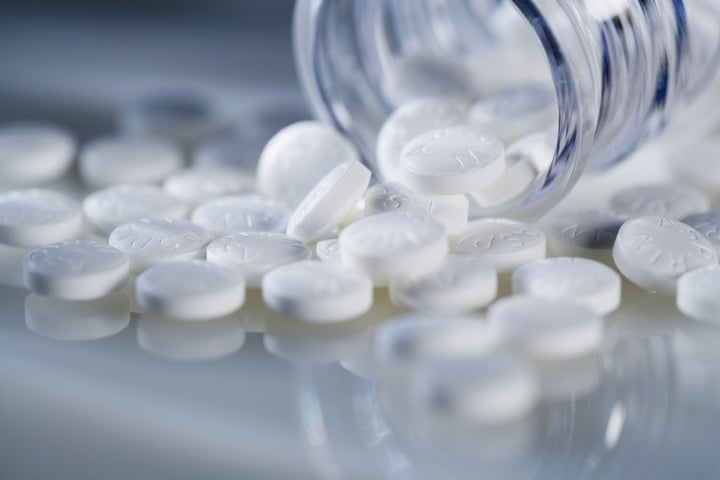
Tetra Images via Getty Images
For people without heart disease, the picture has changed over the past decade, explained Dr. Robert Brook, a tenured professor of internal medicine and executive director of cardiovascular prevention at Wayne State University School of Medicine.
“Several large clinical trials conducted within the past decade across a range of patients ― including higher-risk patients with diabetes ― without heart disease showed that the risks, such as gastrointestinal bleeds or intracranial hemorrhage, are roughly equal to the modest benefits in reducing a first heart attack,” he said. “One possible reason for the lower benefit seen in recent trials than expected is the wider use of statins and a societal secular trend in fewer events.”
The U.S. Preventive Services Task Force updated its guidance accordingly in 2022.
“Aspirin is no longer recommended for primary prevention in patients over the age of 60 years,” Lawson said.
In other words, adults 60 and older with no history of heart disease or stroke generally shouldn’t start taking aspirin to prevent one.
“Adults aged 40-59 can consider low-dose daily aspirin for primary prevention if their calculated 10-year ASCVD ― atherosclerotic cardiovascular disease ― risk score is >10%, but even this recommendation still remains debated in the field,” Blumfield said.
The American Heart Association also offers a more nuanced recommendation these days.
“Patients are asked to use shared decision-making with their physician to estimate (e.g., risk calculators can be used) the potential harms versus benefits in their unique life situation,” Brook said. “In this context and given the smaller potential benefits compared to safer treatments such as statins, far fewer people are now recommended to take a daily aspirin to prevent the first cardiovascular event.”
Who Should Be Cautious About Daily Aspirin?
“Risks of daily aspirin therapy relate to an increase in bleeding risk,” Lawson said, pointing to issues like stomach inflammation, ulcers, gastrointestinal bleeding and bleeding in the brain.
“The risk of cardiovascular events increases with age but so do the risks of bleeding such that the risk outweighs the benefits,” he added.
Indeed, there’s a bit of a frustrating catch-22 at play.
“The main risks have to do with an increase in bleeding,” Brook said. “This risk increases with age. Unfortunately, the very people who tend to benefit most from heart protection from aspirin are those at greatest risk for problems. As such, the use of preventive aspirin is individualized for each patient.”
In addition to the risk of gastrointestinal bleeding, he listed other “clear reasons to avoid daily aspirin,” including recent surgery, recent cerebrovascular bleed, ulcers, allergies and certain cases of asthma.
“The main risk of aspirin is bleeding due to its effect on platelet aggregation, and therefore anyone at increased risk of bleeding should have a conversation with their doctor before initiating aspirin for any reason,” Blumfield echoed.
Other medications can compound the problem and add to the benefit/risk analysis.
“Aspirin tends to not have significant interactions with other medications, but if someone is also taking a blood thinner such as Eliquis, Xarelto or Coumadin for a separate indication, the bleeding risk may be compounded,” Blumfield said.
What People Should Know About Dosages
The doctors who spoke to HuffPost were emphatic that bigger isn’t necessarily better when it comes to doses of aspirin (despite what Trump’s “monster” comments might suggest).
“Low-dose ― 81 mg daily ― is the general dose we use for both primary and secondary prevention in the world of cardiology,” Blumfield said. “To my knowledge, there is no data showing improved outcomes on higher doses.”
U.S. studies show 81 mg of aspirin has the same chronic efficacy as a 325 mg dose for everyday prevention of cardiovascular disease, Lawson noted.
“A higher dose increases the risk of bleeding events,” he added. “In the setting of acute events ― an acute heart attack, angioplasty and stenting ― a higher dose is administered acutely followed by a lower maintenance dose.”
Brook stressed that the risk-benefit ratio for lower-dose aspirin is superior to higher doses.
“This is not in question,” he said. “Doses above 81 mg are not warranted and negate the potential benefits by substantially increasing the risks. It’s settled medical science and clinical practice.”

Roberto Schmidt via Getty Images
As for the president’s daily 325 mg habit for “cardiac prevention,” some doctors have thoughts.
“This exceeds the recommended doses of 81 mg for patients with established coronary artery disease and may contribute to the bruising sometimes seen on his limbs,” Lawson said.
Trump and his White House team have previously attributed the bruising on Trump’s hands to frequent handshaking combined with his aspirin regimen.
Other experts who spoke to HuffPost were careful not to weigh in on Trump’s specific care but emphasized that the decision to take daily aspirin should take into account any previous cardiovascular events or diagnoses.
“I am not familiar with our president’s medical history, but if he has a reason for secondary prevention aspirin, he should certainly be taking it, as long as the risks and benefits have been discussed with his physicians,” Blumfield said.
“Every single patient is different,” Katz said. “If his doctor recommended it, then without seeing the entirety of his medical history and tests and knowing his family history, then it is impossible to comment on his medical care.”
Whatever your specific situation, don’t start or stop taking daily aspirin on your own.
“This is a complex decision that should be considered in discussion with their physician ― or even with the guidance of a specialist such as a cardiologist,” Brook said. “Those with a prior heart attack, coronary revascularization or stroke should never stop their aspirin without talking to their physician. Most people with heart disease require lifelong aspirin, or an alternative anti-platelet therapy.”
It’s best to try to understand the reasoning behind any medicine you’re prescribed and what it does to your body.
“This is true for any medication,” Blumfield said. “But know why you are advised to take the medication, what the possible side effects and complications may be, what are the dangers of stopping abruptly, and what interactions it may have with any other medications you are taking.”











.png)





.jpg)



 English (US) ·
 French (CA) ·