

.png) 4 months ago
81
4 months ago
81
PROTECT YOUR DNA WITH QUANTUM TECHNOLOGY
Orgo-Life the new way to the future Advertising by AdpathwayThere are countless indignities in being a woman (and especially a woman journalist) in the second term of Donald Trump’s presidency — and CNN’s White House correspondent Kaitlan Collins seems to have experienced more than her fair share.
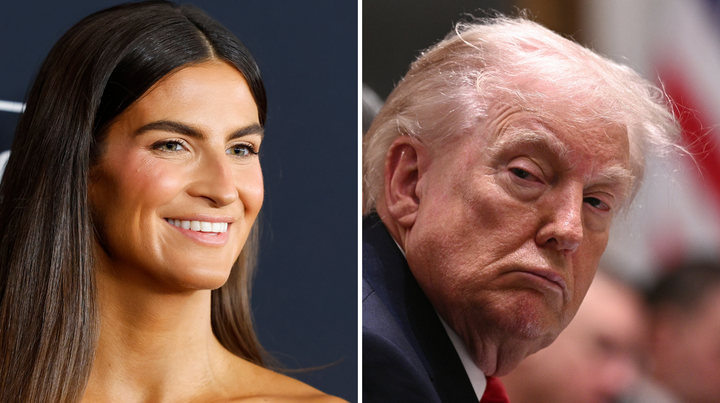
On Tuesday, during a heated exchange in the Oval Office, Collins attempted to ask the president about the latest release of files related to Jeffrey Epstein — a cause he’s gone from caring enough about to prepare “Epstein File” binder props for influencers to dismissively wondering why people are “still talking about” the prolific pedophile.
Collins tried to press the president on details about his allies (billionaire Elon Musk and Commerce Secretary Howard Lutnick) appearing in the latest drop of documents (alongside the president himself, thousands of times) and attempted to ask about getting justice for the victims and survivors of Epstein’s crimes. She did not get an answer.
“You are the worst reporter. No wonder CNN has no ratings, because of people like you,” Trump said, continuing to speak over, interrupt and insult her (he does that), while insisting that “nothing came out” in the documents about him and that the media and the country should focus instead on “something that people care about.”
“I don’t think I’ve ever seen you smile,” he continued. “I’ve known you for 10 years. I don’t think I’ve ever seen a smile on your face. You know why you’re not smiling? Because you know you’re not telling the truth.”
Getty Images/Huffpost
In a year when we’re seemingly just reliving 2015-2016, it’s a shame that we have to do this again. It felt like most of us litigated the “it is decidedly creepy and gross to tell women to ‘smile’” debate a decade ago.
Yet here we are, witnessing the same playbook Trump has long used to demean a reporter (with a dash of his usual Deny, Attack, Reverse Victim and Offender technique) — especially when it’s a woman asking about his relationship with Epstein.
Call it what it is: a sexist microaggression.
Microaggressions like this, as Derald Wing Sue, professor of psychology and education at Columbia University, told HuffPost via email, “are the everyday slights, insults and invalidations that are directed toward socially devalued groups (People of Color, Women, LGBTQ+, etc.) in our society.”
These behaviors can be “conscious” or exist “outside the level of awareness of the perpetrator,” he said, but the consistent through line is that they “almost always contain meta-communications (hidden) that derogate, blame or attack the target’s competence.”
“The interaction between Trump and Collins is a complex interaction of gender microaggressions. The most prominent one is Trump’s assertion that he has never seen Collins ‘smile,’” Sue continued. “Such a statement could be made about many male reporters as well. But it has a major impact on women because the meta-communications sent to Collins (and viewers) are: ‘Women should be warm, loving, docile, affectionate and show these traits through ‘smiles’ and outward expressions of friendliness.’”
“Her lack of a smile breaks these gendered feminine roles and she is being punished for being task-oriented, assertive and aggressive (masculine roles). In other words, she is being told, ‘let experienced men’ take the lead,” Sue continued, adding that Trump’s dismissal of her as a “young woman” also pushes the insult that she was “incompetent, inexperienced, not knowledgeable, less capable and should let others (men) take the lead.”
Trump is using sexism to shield himself.
So this is absolutely a rude thing to do to a person, for obvious reasons: It’s no one’s job to perform a facial expression, least of all someone asking questions about something as universally devastating as the Epstein case.
But the “you don’t smile enough” criticism is also employed here (much like other appearance-adjacent attacks from Trump) as a purposeful dominance maneuver, meant to reinforce those meta-communications to Collins and other journalists and “punish” the behavior that refuses to conform or submit to his sexist standard.
And in this case, it sure looks like it’s a punishment for asking legitimate questions about how the current administration is handling the Epstein case.
“So what is happening is an attempt to change the subject by using microaggressive tactics to detract or sidetrack the true conversation,” Sue said. “Also, if you attack the credibility of the person (Collins), the legitimacy of the issue being raised is diminished. ”
Trump’s comment itself may be easy to mock — but the worldview it reinforces is one that is increasingly closing in via the meta-communications from many prominent conservatives lately, via tradwifery and weird comments about our brains, bodies, choices and voting rights, that reinforce that you do not belong in public life and should “know your place.” It’s a body check, meant to maintain that misogynistic order and discourage dissent— and far too often, it works.
“If you attack the credibility of the person (Collins), the legitimacy of the issue being raised is diminished.”
- Derald Wing Sue, professor of psychology and education at Columbia University
For another story around the ambient misogyny of the second Trump administration, HuffPost spoke with Soraya Chemaly, author of “All We Want Is Everything: How We Dismantle Male Supremacy,” who unpacked several of the ways this administration’s attitudes toward women align with male supremacy.
Chemaly likens the quiet, often unchallenged ways a male supremacist power structure maintains its order to what we see with street harassment, especially given the public nature of the behavior.
“If you think about the way street harassment works, everybody’s witnessing it,” Chemaly said. “We’re trained into compliance, right? People know it’s happening. They dismiss it or they minimize it, but it still has the effects that it has broadly on women or on minorities.”
It’s this collective training on display when bystanders do nothing when witnessing gendered harassment in the wild. Sue notes that studies on microaggressions have shown that the role of bystanders — and the inaction or actions they take —have “a major impact on perpetrators, targets, allies” and other bystanders.
This dynamic is noticeable in the moment where Trump looks to the room, remarking that Collins is a “young woman” to others in his company first before addressing her directly in his rant about her lack of smiles.
“Inaction on the part of other reporters and viewers on television communicates that such statements are OK and creates a hostile and invalidating environment, as many of Trump’s news conferences and Q/A sessions are like,” Sue noted. “The rise in public incivility or expressions of bias have been found in psychological studies to foster bias contagion and less civility.”
Purposefully demeaning and trying to embarrass Collins while engaging with those (seemingly) silent bystanders can betray how normalized these views still are — and misrepresent them as socially acceptable. It’s an intentional attempt to triangulate the other players in the room against a woman who, in the mind of a misogynist, stepped out of line.





.png)





.jpg)



 English (US) ·
  French (CA) ·