

 7 months ago
91
7 months ago
91
PROTECT YOUR DNA WITH QUANTUM TECHNOLOGY
Orgo-Life the new way to the future Advertising by Adpathway
The human capacity to sculpt the terrain that surrounds us is enormous but not without limits. While a farmer or a gardener may replace or modify the geographical and botanical features on a given piece of land, it is only quite rarely, and with the help of an enormous expenditure of very scarce resources, that he can, say, turn a sizable hill or mountain into a lake or a plain.
The work of tilling the land and making of culture are, in English and in numerous other languages, are linked on the etymological level, with both being derived from the Latin verb colere whose varied meanings include “to cultivate,” “to care for,” “to tend to,” “to honor,” “to revere,” “to worship,” or “to embellish.”
And while it would be absurd to suggest that an implied element of one derivation of a given verb in some way conditions the semantic content of another, I can’t help but wonder whether the limitations implicit in the act of cultivating the land as described above might nonetheless help us better understand those that relate to the making of culture.
In other words, could it be that there are “hard” cognitive structures and/or yearnings within us that might delimit the extent to which we can actually generate the wholesale ruptures with the past ways of being and thinking?
For example, it is quite common for historians to speak of the 19th century as the Age of Nationalism, which is to say, the time when the nation-state established itself as the normative form of social organization in Europe and much of the rest of the world.
And most of them, being secular people themselves, have sought to explain this “rise of the nation” in secular ways, which is to say in terms of grand political theories, sweeping economic transformations, the writings of intellectuals, and the actions of powerful politicians and generals.
However, a smaller number of scholars, observing the great and often bloody passions which the nation-state has evoked among the masses, and that its rise largely coincided with the first great decline in religious practice in most Western countries, have suggested that it might be more accurate to portray the nation as merely a new, secularly-inflected receptacle for timeless yearnings—such as a desire for social unity and an engagement with the transcendent—that were previously “serviced” by organized religion.
A small number from this latter group, such as Ninian Smart and David Kertzer, have gone on to analyze the myriad cultural practices deployed in the name of nationalism in light of traditional Western ritual, sacramental, and liturgical processes. Their work makes for fascinating reading.
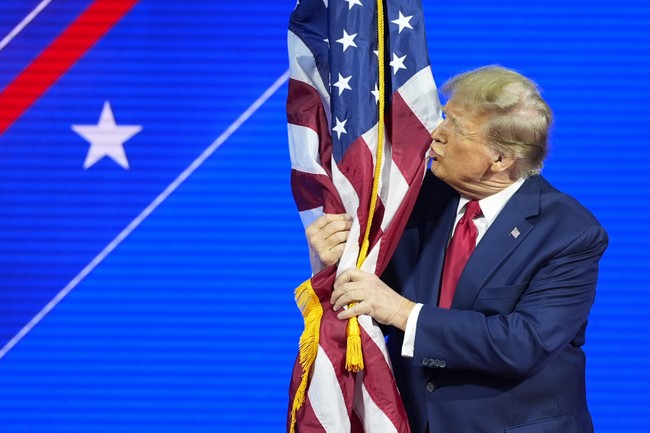
Smart, for example, outlines several of the ways in which national movements partake of patterns common to religions. The first is to “establish the mark” which separates the believers from the non-believers. The second is to engage in performative rituals that celebrate the mark in the name of a set of spiritually “charged” materials (e.g. ancestors, war heroes, great scholars, or simply the “sacred” earth that provides sustenance to the community), rituals designed to lift the citizen from the humdrum of his everyday existence and into a relationship with forces that transcend his standard, lifespan-delimited, sense of space and time.
He also noted how the solemn celebration of the spilling of citizen blood in defense of the “marked” national terrain is customarily portrayed in this context as a sacramental act that greatly heightens the sacred “charge” within the collective while also cleansing it of some of its less desirable attributes or habits.
The end goal of these rituals, he argues, is to evoke a sense of psychic subordination in the common citizen, a lowering of the self that Smart compares to the way we—or at least those of us born before 1990 or so—were acculturated to abandon our customary modes of comportment when entering a church or another space identified as being a portal to transcendent forces. “By a kind of self-deprecation or self-restraint I reduce my value somewhat and communicate sacrificed value to what is sacred. But such proper behavior opens up the interface between me and the sacred, and in exchange for my self-deprecation I gain the charged blessing of what is sacred.”
The end result of this psychic transaction is, he argues, a “performative transubstantiation whereby many individuals become a superindividual,” a status, he goes on to suggest, that fortifies that same individual against the dissolvent forces of industrial modernity with its greatly enhanced mobility, new fast forms of communication and, paradoxically, the “voracious demands” of the very state that individual has been trained to venerate.
Kertzer, a scholar of contemporary Italy, affirms the enormous role that rituals of an implicitly religious cast play in the initial consolidation of a national identity. However, he also underscores their crucial importance, as in cases, such as Mustafa Kemal’s Turkiye or Mussolini’s Italy, where powerful elites set out to radically and swiftly overhaul long-standing codes of cultural and national identity, noting how these pedagogues of nationhood often co-opt historical tropes, that on the surface of things, often appear to be completely antithetical to their program of ideological rupture.
It is clear, for example, that strengthening the Italian nation was far more important to Mussolini than helping or supporting the Catholic Church. In fact, like most Italian nationalists of the late 19th and early 20th centuries, he saw the long-standing power of the church as one of the foremost impediments to achieving true national unity and power.
Read More: The Sacramental Underpinnings of Vaccine Culture













.png)





.jpg)



 English (US) ·
  French (CA) ·