

 1 day ago
1
1 day ago
1
PROTECT YOUR DNA WITH QUANTUM TECHNOLOGY
Orgo-Life the new way to the future Advertising by Adpathway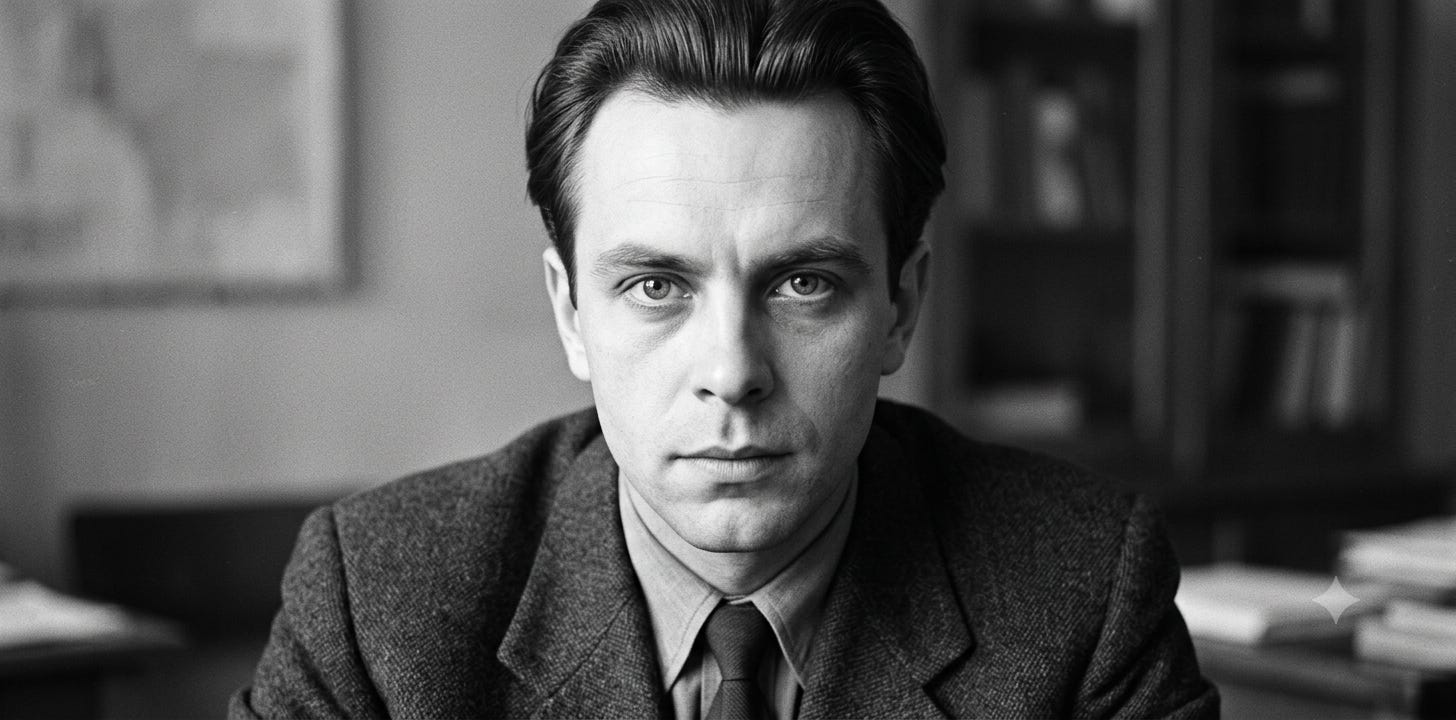
The stage of modern philosophy and political theory has for a long time now been witness to an operation whose purpose is to pull the teeth of revolutionary theory, to immobilize it, and to turn it into a harmless academic hobby in the corridors of bourgeois universities. The most organized, most refined station of this operation within Western academia—the one that has carried the most water to the mill of anti-communism—is the structuralist and post-structuralist construction of "Marx" led by Louis Althusser, Étienne Balibar, Pierre Macherey, and their heir Antonio Negri.
The sole objective of this intellectual purge is plain: to sever Marx entirely from the historical, dialectical, radically transformative vein of German Classical Philosophy (Kant–Fichte–Hegel), and to imprison him instead within an ahistorical, subjectless, paralyzed Spinozism.
To expose the theoretical damage wrought by this ill-omened academic fashion, and to lay bare once more the rationalist backbone of Marxism, one must turn to one of the most unshakeable barricades of intellectual honesty: the Soviet thinker Evald Vasilyevich Ilyenkov (Эвальд Васильевич Ильенков). Refusing to fit the West's shallow cliché of the "dissident intellectual, victim of a totalitarian regime," Ilyenkov, with an uncompromised fidelity, defends Marx's method in Capital while offering, at the same time, the antidote to the great lie by which Western academia has immobilized Marxism.

To situate Spinoza within his own age, and to grant him the value that is his due, is a matter of philosophical honesty. Spinoza wholly rejected the figure of a transcendent, deist God—a clockmaker who creates the world and then withdraws from it. His greatest blow to the history of philosophy was to declare the clock itself, that is, the laws of nature as such, to be God (Deus sive Natura). God is not a founding or intervening king standing outside nature; God is nature's own necessary, unfailing web of causality—immanence in the fullest sense of the word. This move marks an immense historical dawn, the moment at which theology comes to an end, destroying itself from within and cracking open the door to materialism.
Yet this theoretical summit is, in a manner altogether different from Hegel's, the furthest limit of Spinoza's philosophy short of dialectical materialism. For in Spinoza these immanent laws of nature are eternal, everlasting, geometric, and motionless. Before this vast cosmic mechanism, the human being is nothing more than a passive spectator who can, at best, grasp those necessary laws intellectually and strive toward an intellectual assent to that order (amor intellectualis Dei). In Spinoza's philosophy "negation" is not a constitutive force; every determination is merely a restriction (determinatio est negatio). There is consequently no room in this philosophy for a revolutionary will, a class consciousness, or a historical temporality capable of radically abolishing what exists and constructing something new in its place. Everything is simply the necessary flow of the infinite attributes of a given substance.

The theoretical "mash-up" proposed by Althusser and his heirs, placing Marx and Spinoza side by side, is not a philosophical synthesis but an ambush engineered to pull the transformative teeth of Marxism. Not a single sentence, not a single text exists anywhere in Marx's own writings suggesting that he built his philosophical foundations upon Spinoza or drew his inspiration from him. Marx's true genealogy runs through Kant's critical philosophy, through Fichte's emphasis on action (praxis), and through Hegel's law of historical-dialectical negation, which Marx set upon materialist ground. In the philosophical texts he wrote before Capital, and in Capital's own preface, Marx proudly declares himself Hegel's pupil, while he mentions Spinoza only as a historical forerunner of French materialism.
When Western academia deliberately severs the Hegel–Marx bond and proclaims Marx a Spinozist, it evaporates the very ideas of "class struggle," "crisis theory," and "historical progress" from within Marxism. Althusser's theories of the "Ideological State Apparatuses" or the "process without a subject" present ideology and structure as so immanent, so inescapable, so all-enclosing a mechanism that it becomes theoretically impossible for the individual, or for the working class, to step outside that circle. Ideology inducts the human being as a subject of the process before birth, articulates him, and reduces him to a mere carrier of structures.
Just as the human being's hands are bound before the laws of nature in Spinoza, so too is the revolutionary subject paralyzed before the immanence of capitalist structures in academic Marxism. This gloomy structuralism has furnished direct logistical support to postmodernism's theses of "the end of history" and "there is no alternative," breeding among left intellectuals a profound resignation and inertia. The theories of the "Multitude" that Antonio Negri produced by taking up this line envisage not a constituent proletarian force capable of overturning the system at its root, but a harmless form of opposition that merely "tries to exist" within the system's immanent limits, never able to surpass them.

The most powerful philosophical and political concept for shattering the static, mechanical, deterministic mold in which Western academia has imprisoned Marxism is the concept—later consolidated by Lenin—of the revolutionary crisis (revolutionäre Krise), the crisis pregnant with revolution.
The German terms for crisis (krisenhaft, krisenbetont, widerspruchsorientiert) point to the inevitable contradictions arising from a system's own internal movement—what Marx called the immanent contradiction (immanenter Widerspruch). A system enters crisis not because it has malfunctioned, but precisely because it operates unfailingly according to its own objective laws. Seen this way, crisis is not a static landscape but a fertile process in motion, one that carries within it a great philosophical and political tension.
By its very nature, this process is pregnant with revolution. As with any pregnancy: every pregnancy may end in birth, or it may not—it may end in abortion, in miscarriage, or simply dissolve unresolved in the womb. That fatalistic, deterministic fable of "necessity," which presents Marxism as an automatic railway line and history as a mechanical train journey with predetermined stops, is the greatest philosophical trap bourgeois ideology has produced to paralyze left intellectuals. Revolution is not a necessity; it is a contingency (Kontingenz).
It is precisely here that the heaviest blow must fall on the well-known tweezer-picking habit of the academic Marxists. In Marxism, historical progress is never, under any circumstance, a teleological process. History is not a religious, metaphysical river destined to flow toward a predetermined "happy ending" or toward absolute communism. Neither in Spinoza's geometric flow of substance, nor in Hegel's self-realizing idealism of the "Absolute Spirit," is there any room for a revolutionary contingency. While the tweezer-pickers try to extract a linear template of progress from Marx's texts, they evaporate contradiction—the very lifeblood of dialectics.
Historical progress is not a straight line but an open-ended field of struggle, discontinuous and marked by leaps, carrying at every instant the risk of regression—into barbarism or restoration. A crisis pregnant with revolution requires that both objective and subjective conditions ripen in the same historical moment. The influence of the revolutionary vanguard party and its will to intervene in history constitute the subjective condition. If that conscious will to intervene is absent from the stage, then no matter how ripe the objective conditions may be, the contingent window of possibility that history has opened will simply pass, unresolved by any revolutionary birth.

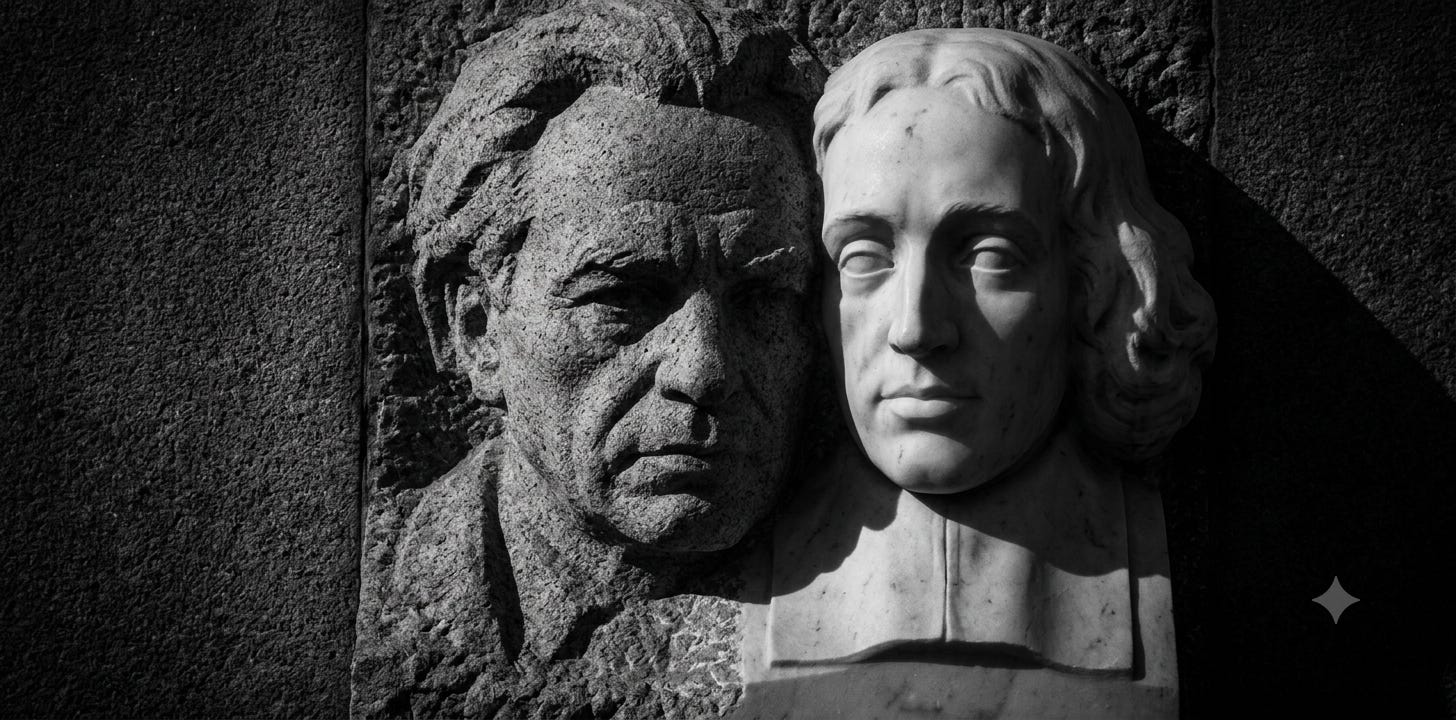
The most fundamental law of the history of philosophy is not to reject the great accumulation that precedes it, but to sublate it (Aufhebung)—to include it while surpassing it. To draw upon Kant, Hegel, or Spinoza does not make a philosopher a disciple of that philosophy. Ilyenkov's genius lies precisely here: unlike the academics who adopt Spinoza as dogma, he draws on Spinoza as a Marxist, setting him back upon his feet. Ilyenkov did to Spinoza exactly what Marx had done to Hegel.
Against Cartesian dualism, which splits the world into spirit and matter, subject and object, and against bourgeois agnosticism, Ilyenkov draws on the power of Spinoza's monist unity. Thought is neither the crude organic secretion of the brain that vulgar materialists and positivists claim it to be, nor the celestial substance detached from matter that idealists imagine. Thought is the mode of activity of nature's most highly organized form—the way it relates to, and practically acts upon, the objective world beyond itself.
But Ilyenkov does not stop there: he presses Spinoza's frozen, human-excluding immanent laws down onto the ground of human labor, social production, and historical praxis. Here it is vital to make a distinction, at both the linguistic and conceptual level: against the ruling ideology's effort to portray revolutionary theory as a blind, vandalistic destruction (destruktiv, zerstörerisch), the Marxist-Hegelian line has always championed a constitutive abolition.
Ilyenkov's method of incorporating Spinoza is not a simple refutation; philosophically it is an act that is at once umwälzend (a radical overturning, a revolutionary transformation) and, in the fullest sense, aufhebend (including while surpassing, cancelling while preserving). Ilyenkov negates Spinoza's theological and mechanical limits, surpassing them; yet he preserves, within the crucible of dialectical materialism, Spinoza's more advanced elements—his rationalist unity and his monism. Spinoza's philosophy is thereby lifted off its head and turned into a constituent force on the ground of historical-social praxis.

Ilyenkov's original contributions to philosophy are of a kind that shatters every barricade of immobilization that Western academia has tried to erect. His theoretical legacy rests upon four great pillars:
A. The Methodology of Ascending from the Abstract to the Concrete
Against the vulgar materialism that reduces dialectics to a mere "law of nature" or a bundle of mechanical formulas, Ilyenkov insistently defended the logical spine of Capital. Bourgeois philosophy and crude positivism treat empirical data—what can be seen and touched—as "concrete," and theoretical concepts as "abstract." Ilyenkov inverts this epistemology: what is truly abstract is precisely the isolated empirical datum, severed from its internal connections.
The concrete, by contrast, is the object reconstituted in thought with all its internal contradictions, its historical development, and its totality. Marx's method, then, is not the production of abstract dogmas but the act of rendering reality concrete in thought, in the fullness of its dynamism. This approach removes Marxism from the register of a dogmatic system of belief and turns it into the scientific toolbox for transforming the objective world.
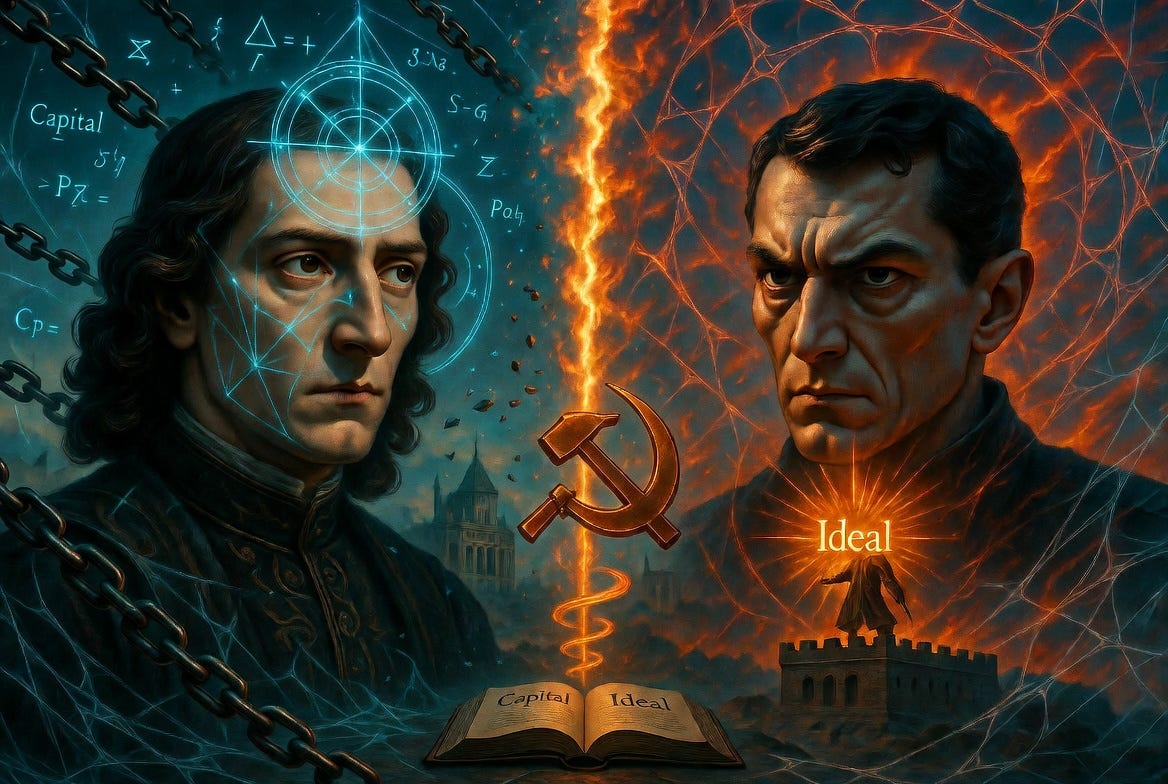
B. The Theory of the "Ideal" (Идеальное, Idealnoye) and Its Social Concretion
The most original concept Ilyenkov left to the history of philosophy —one that readers can explore in greater depth through his Dialectical Logic: Its History and Theory— is his theory of the "Ideal" (Идеальное). Western philosophy either imprisons the ideal within consciousness (subjective idealism) or rejects it outright in the name of crude materialism. Ilyenkov demonstrates instead that the ideal becomes concrete in the objective world through human activity and labor.
When a piece of metal acquires, through human labor, the form of "money," that metal is no longer merely a physical object; it now embodies, in itself, the social-economic relations among human beings. Language, culture, law, and values are objective-ideal forms, independent of the consciousness of any single individual, forms that social human labor has carved into the world of objects. This theory succeeds in explaining the cultural and social sphere on an entirely materialist and objective ground, without falling into either mysticism or idealism.

C. The Zagorsk Experiment: The Social Construction of Consciousness
Ilyenkov did not leave the thesis that consciousness and thought are not biological or genetic givens, but wholly products of social labor, as mere theory—he proved it through a practical experiment. His philosophical and psychological work at the Zagorsk boarding school, where children who had lost their sensory faculties entirely as a result of severe illness in infancy or early childhood—children classified as "pedagogically deaf-blind"—received their education, stands as the greatest triumph of his materialism.
Children with no functional sensory connection—visual or auditory—to the outside world, and for whom the development of language and consciousness was therefore considered biologically impossible, were taught to form a practical, instrumental relationship with objects—that is, to labor. As these children learned to hold a spoon, to use a table, to form a practical bond with the humanized world of objects, their minds, their language, and their human consciousness were built up from nothing. That one of these children, Alexander Suvorov, would go on to earn a doctorate in philosophy stood as concrete proof of Ilyenkov's thesis that consciousness is the embodied act of social labor. Consciousness was not a secretion of the brain; it was the product of social praxis.

D. The Liquidation of Idealist-Empiricist-Positivist and Bourgeois-Liberal Attacks on the Zagorsk Experiment, and Their Sources
Western academia has more recently claimed that some of the children who took part in the Zagorsk experiment—Alexander Suvorov in particular—retained brief periods of sight and hearing in early childhood, between roughly four and nine years of age, and that this empirically refutes the thesis of consciousness being built "from nothing." These circles, drawing especially on statements Sergey Sirotkin made in later years, and on the technical and pedagogical limitations behind the Soviet-era classification "pedagogically deaf-blind" (pedagogicheski slepoglukhoy), seek to present the theses jointly consolidated by Ilyenkov and Alexander Meshcheryakov as a piece of "Soviet rhetoric" or "ideological fabrication."
But this crude offensive has nothing whatsoever to do with dialectical materialism; even as it takes refuge in objective data, it is thoroughly idealist, precisely because it leaves human praxis out of the picture. It is an empiricist-positivist, bourgeois-liberal refutation attempt, and the sources on which it rests, along with the philosophical poverty into which they fall, must be pulverized on two fronts:
1. The Illusion of Sources, and the Ambush of Idealist Positivism
The bourgeois mind, presenting this as a "methodological rupture" in its reports, attempts to drag Ilyenkov's theory of the "ideal" and of consciousness onto the ground of crude biological determinism and fact-fetishism. Yes, Alexander Suvorov's biographical records confirm that he could see until age four and hear until age nine; likewise, Sergey Sirotkin and other members of the group are confirmed to have had empirical sensory contact with the world in early childhood. Neither Ilyenkov nor Meshcheryakov were mystical miracle-hunters claiming that these children had no neural, cellular, or sensory history whatsoever. What they demonstrated, philosophically and psychologically, is a different fact altogether: that human-social consciousness, conceptual categories, and linguistic forms are not transmitted genetically through biological inheritance.
By the time Suvorov and his companions arrived at the experimental center in Zagorsk, nothing remained of those early, transient sensory experiences—no functional connection, no linguistic mechanism, no conceptual world; they had, objectively, regressed to the level of a "biological organism" wholly isolated from the world. The literature's designation "pedagogically deaf-blind" points to precisely this material fact: whatever biological remnants existed represented an absolute zero point for conventional education and humanization.
Empirical positivism, by presenting those dull remnants and given structures as transcendent absolute laws independent of human beings and social praxis, falls into the trap of an idealism disguised as objectivity. If the matter were, as those shallow academics claim, simply the "rehabilitation of a damaged biological faculty," then the thousands of deaf-blind children in the bourgeois world would have become philosophy doctors on their own, with nothing more than medical or technical apparatus. Zagorsk's triumph is precisely this: that even those dulled, effaced biological remnants of the past could be transformed into a human consciousness—into philosophical genius—only within the crucible of human-social labor and practical activity: holding a spoon, transforming an object, using a tool. This empiricist posture, which absolutizes facts and structures while denying human will and constitutive social praxis, is a secular objective idealism produced by the bourgeois world.
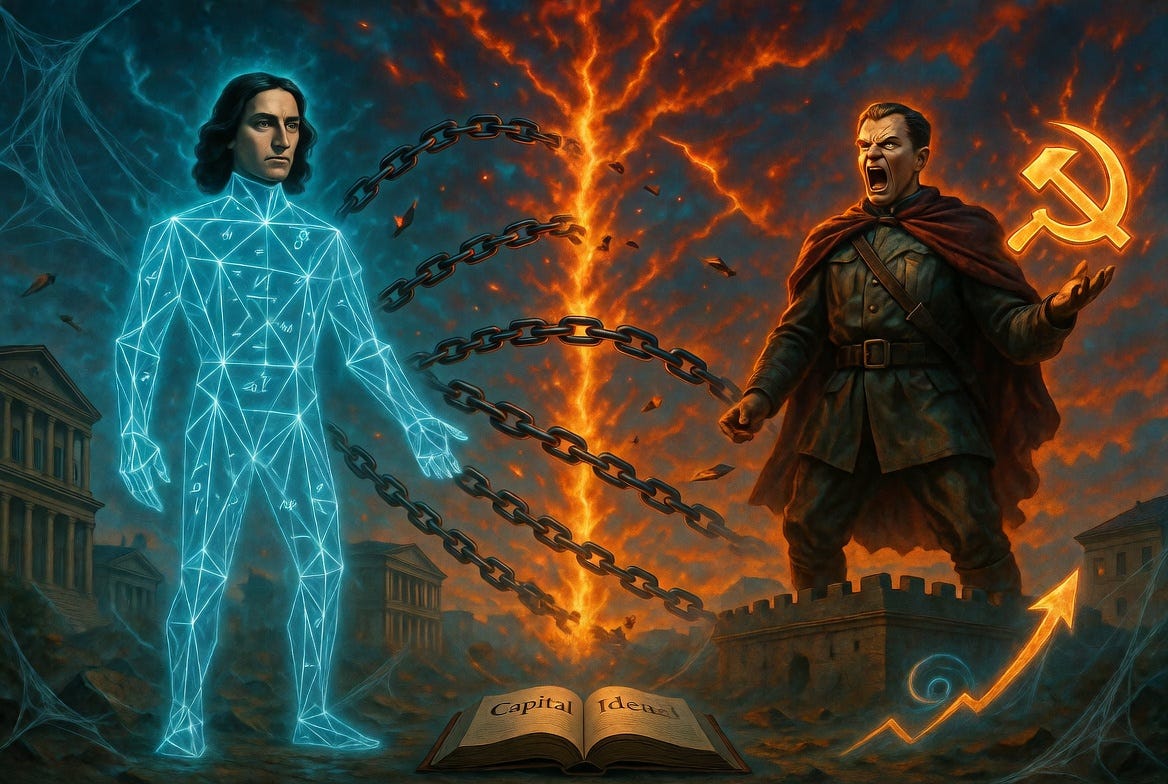
2. Part of the Operation of Tooth-Pulling and Domestication
This empiricist assault is a direct, practical reflection of the very operation this essay exposed at the outset—the sly, sweeping operation to pull the teeth of revolutionary Marxism and turn it into a harmless academic hobby.
Why does Western academia attack the Zagorsk experiment and the material evidence on which it rests with such intense hostility? Because Zagorsk proved, in practice, that human consciousness and subjectivity are never eternally imprisoned by given genetic structures or by empirical history—that they can be radically constructed, in full, through social praxis: revolutionary action and labor. To condemn consciousness to biology, to past empirical data, or to those inescapable objective-idealist structures that the Althusserians claim paralyze the human being before birth, is to have already liquidated the revolutionary subject in advance.
The bourgeois-liberal offensive that tries to brand Zagorsk's practical triumph as "fabrication" delivers a sly message to the working class and its revolutionary vanguard: "You cannot step outside given structures, past empirical conditions, or biological limits; the subject can only be rehabilitated within the bounds the system permits." It is precisely at this point that Ilyenkov's trench philosophy shatters this ambush of domestication. Zagorsk is not a "damage repair center" but a constituent trench in which the human being remakes itself through social practice. Those biographical data the other side waves about as a "refutation document" are, in fact, revolutionary ammunition sealing our own thesis: that biology alone, without social labor and practice, can produce nothing.

3. The “Italian Event”
Yet, in the mid-1970s, Ilyenkov’s relentless battle in this theoretical trench also turned into a tragic confrontation with the thick walls of the Soviet ideological apparatus, as well as its international extensions and its echoes in the Western world.
This process, recorded in the history of philosophy as the “Italian Event,” sealed the end of Ilyenkov’s quest for rational Marxism against dogmatism, while simultaneously engraving the indelible and defiant character of his Spinozist legacy onto history. This crisis erupted immediately following the publication of Dialectical Logic, his monumental work which stood as his most radical, uncompromising, and systematic philosophical challenge against dogmatism. Feltrinelli, the progressive and intellectual Italian publisher directly affiliated with the Italian Communist Party, recognized the shattering depth of this work and sought to translate it into Italian and publish it in the Western world.
For the Soviet philosophical bureaucracy and party apparatuses, this move represented an unacceptable leak and meant that an interpretation of Marxism outside the official Diamat templates would gain legitimacy. The Soviet Institute of Philosophy and ideological committees exerted psychological and political pressure on Ilyenkov to correct the most revolutionary, Hegelian, and Spinozist parts of the book, to bring it into alignment with the official philosophical view, and to immediately sever all ties with Feltrinelli. Ilyenkov resolutely refused to compromise his theoretical integrity or to bow down. Consequently, the book was published uncensored in Italy, but the Soviet “philosophical bureaucrats” launched a domestic ideological excommunication against Ilyenkov. Accusing him of collaborating with Italian revisionism, they completely isolated him, restricted his academic reach, and banned him from publishing. This ideological blockade initiated the process that dragged his final years into deep loneliness, isolation, and ultimately led to his tragic suicide in 1979.
However, the “Italian Event” was as much a monumental triumph for his philosophical legacy as it was a profound tragedy for Ilyenkov the man; because, like Spinoza’s indestructible, immutable substance, it proved that Ilyenkov’s dialectical rationalism could never be obliterated by any mechanism of suppression.

Unlike the academic charlatanism that tries to substitute Spinoza for Marxism, Ilyenkov reads Spinoza as the dawn of historical dialectics. He takes him up and places him in the service of Marx's analysis of socio-economic formations, in the service of class struggle. In Spinoza, immanent laws determine the human being eternally and hold him motionless; with the line of Marx and Ilyenkov, the human being becomes both the constituent of those immanent social laws and the sole active subject capable of radically transforming them through revolutionary action.
The West's academic Marxism has turned Marxism from a manual of action in the hands of the masses into a harmless hobby consumed within bourgeois universities. The legacy of Evald Vasilyevich Ilyenkov, by contrast, is an uncompromised barricade of intellectual honesty that exposes this ill-omened structuralist operation, restoring philosophy to the rationalist, revolutionary character of the Kant–Hegel–Marx line—a character rooted in the crisis pregnant with revolution and radically transformative to its core. To present him correctly is to restore him to the podium directly, as a philosophy of the trench—without sacrificing him either to the template of the liberal dissident who claims to topple the system from within, or to the subjectless structuralist mash-up.
◇Artificial Intelligence (AI)has been used solely as an enhanced search engine for the purpose of data verification.













.png)






.jpg)



 English (US) ·
  French (CA) ·