

PROTECT YOUR DNA WITH QUANTUM TECHNOLOGY
Orgo-Life the new way to the future Advertising by Adpathway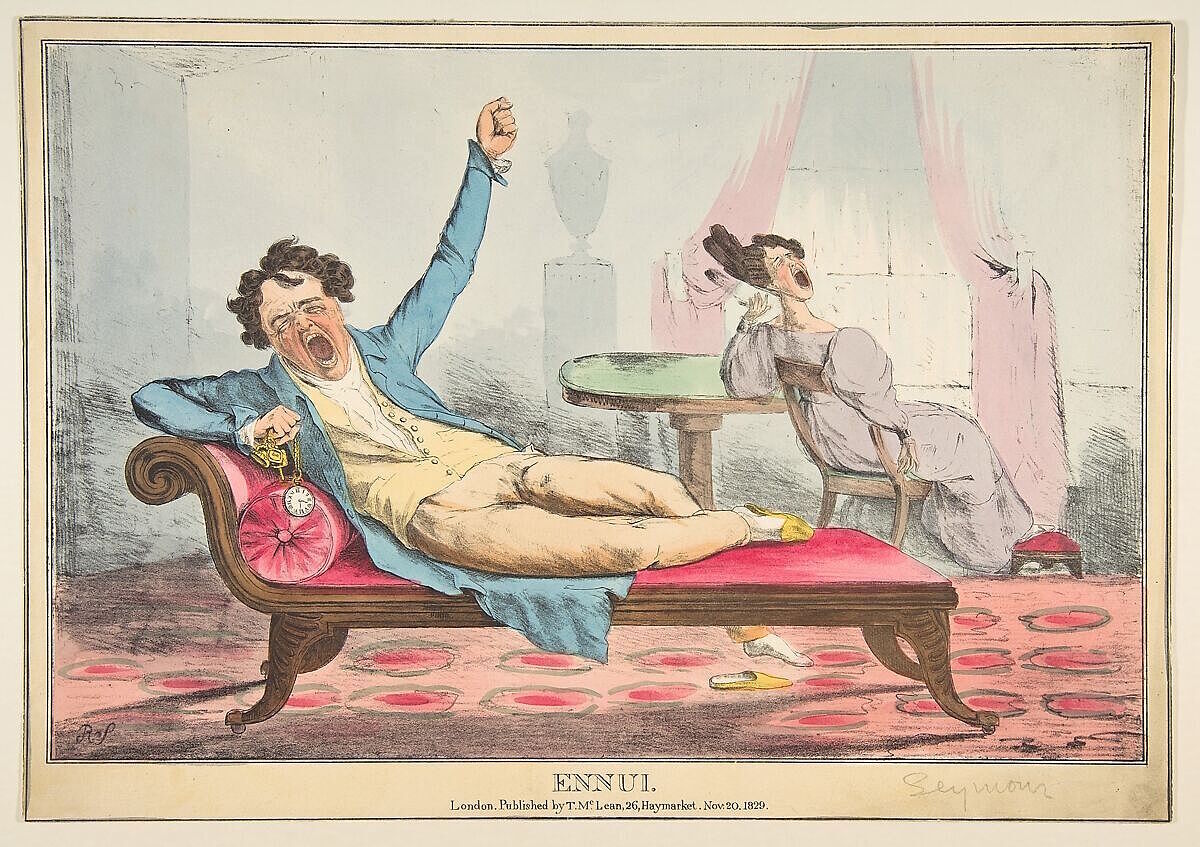
© Metropolitan Museum of ArtEnnui - Robert Seymour, 1829
A couple weeks ago I wandered into a digression about toxic workplaces. Consider this week's Nightcrawler another small detour into the forgotten value of boredom.
Last Saturday, our four-year-old didn't sleep well. So on Sunday morning, I did what many semi-desperate parents have done for generations: I loaded her into her carseat, and set out for a long, pointless drive to get her to fall asleep.
Thankfully, the ruse worked. As we wound our way toward the Oregon coast, she nodded off after a promised donut. I reached for my headphones, ready to salvage my odyssey with a podcast or something vaguely productive. And then: disaster. I realized I'd forgotten them.
At first, I was bored. My brain, conditioned by a decade of smartphone use, kept reaching for the familiar dopamine drip of constant input. And I know I'm not unique in this. Most of us have become habitual grazers of digital noise... which is the polite way of saying we've become information junkies, always craving our next hit.
But about half an hour into the drive, once my initial agitation faded, my mind finally began to wander. A problem I'd been wrestling with for weeks suddenly clicked into place. I'd daydreamed myself into a resolution. Later, I laughed at the irony: doing nothing for an hour — just driving toward the coast on a foggy Sunday morning — ended up being the most productive stretch of my week. Eureka.
The bigger story, of course, is how proudly modern culture has engineered boredom into extinction. Yet boredom — and the kind of aimless mental wandering it permits — has always been one of the mind's oldest creative engines. Boredom is not a menace: it's a cognitive tool, and we've nearly erased it.
In 2014, researchers at the University of Central Lancashire found that participants forced to do a boring task (copying digits from a phone book) later demonstrated higher creativity than those who weren't bored at all. As the authors concluded:
"Until recently, boredom has been viewed as a negative emotion with only negative outcomes, but the current study adds weight to the evidence that suggests that boredom can sometimes be a force for good. This means that it might be a worthwhile enterprise to allow or even embrace boredom in work, education and leisure."In other words, boredom triggers an internal restlessness that pushes the brain to generate its own ideas. There's a saying that "an idle mind is the devil's workshop."
I'd invert that. An idle mind, in fact, is often where the good work begins.
Unfortunately, we've designed modern life to prevent precisely this state. We fill the smallest pockets of time — elevators, checkout lines, crosswalks — with input. Which is why boredom, especially now, feels almost revolutionary.
So here's the idea I keep coming back to: if you want more genuine, original insight, stop filling every moment. Stop being productive. Get bored on purpose. Close your inbox (including this one). Skip the next podcast. Take a walk without headphones. Go for a drive and let your mind drift. As the Buddhist teacher Sylvia Boorstein once said, "Don't just do something — sit there."
P.S. When my daughter woke up with thirty minutes left in the drive, she groaned, "I'm bored." Excellent.

Eric Markowitz Director of Research at Nightview Capital and actively participates in the day-to-day decision-making of the The Nightview Fund. Additionally, he is a prolific speaker and writer who has appeared on NPR, CNBC, and Fox Business. He is also the author of The Nightcrawler, a popular, idea-driven weekly newsletter about investing, business, and technology. Follow him on X






.png)






.jpg)



 English (US) ·
  French (CA) ·