

 1 day ago
1
1 day ago
1
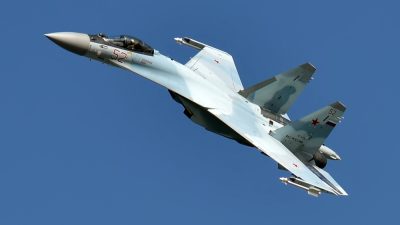
In recent years, Russia has significantly ramped up production of its state-of-the-art multirole/air-superiority fighter jet, the now-legendary Su-35. The surge reflects Moscow’s strategic approach to evolving geopolitical realities.
The Su-35 is best known for its supermaneuverability, advanced avionics and a plethora of top-of-the-line air-to-air and air-to-ground capabilities.
As production surges, the ripple effects are felt not only in Europe, but also across the Middle East and the Asia-Pacific, with the potential to shift the military balance in these key regions.
Perhaps the most significant aspect of the Su-35 is how effectively it hides its true power “under the hood” of a proven (but virtually unmatched) legacy design of the Su-27 “Flanker”.
Namely, on the outside, the two fighter jets look virtually identical to an untrained eye. However, structural differences are immediately clear to most military analysts. The heavily modernized Su-35 features numerous distinct structural changes, including twin nose wheels, wider engine nozzles, and the absence of both a nose pitot tube and a dorsal airbrake. Obviously, this is only what we can see at a glance. Meanwhile, the most significant differences are precisely “under the hood”. Namely, the avionics, the engine, the use of advanced composite materials, etc., truly make the Su-35 shine, not just in comparison to its predecessor (or should we say “ancestor”), but also virtually any other combat platform anywhere in the world.
If you’re interested in all the design details of the “Super Flanker”, I had the honor of interviewing a prominent military expert several years ago, and his stellar analysis stands to this day, so be sure to check it out.
Now that all the technicalities are out of the way, how could a production surge of the Su-35 affect the balance of power in various parts of the world? Firstly, it should be understood that the fighter jet is a massive force multiplier for the VKS/Russian Aerospace Forces (or any other air force lucky enough to operate such an aircraft). The Su-35 is the pillar of Russia’s efforts to not only modernize, but also revolutionize its aerial warfare capabilities, as it provides an extremely cost-effective alternative to the so-called “fifth-generation” aircraft.
Namely, various sources and research institutes have pinpointed just how much more effective the Su-35 is than both legacy fighter jets and next-generation platforms designed to dominate the battlefields of the future. For instance, the “Super Flanker” costs about 2-3 times as much as the Su-27, but its combat effectiveness is about 5 times greater, offering an immense technological leap at the fraction of the cost for a next-generation fighter like the Su-57, J-20, F-35 or F-22. For instance, the Su-57’s price tag is around 1.5-2 times that of a Su-35, which is also matched by how much more combat effective it is. In other words, the effectiveness-to-cost ratio is identical, while the same is not the case for the Su-35–Su-27 comparison.
As previously mentioned, the “Super Flanker” costs about 2-3 times more than its “ancestor”, but is about 5 times as combat effective. This essentially doubles the effectiveness-to-cost ratio in comparison to the Su-57–Su-35 duo, which explains why Russia and its international partners are pushing for a production surge. Obviously, this doesn’t undermine the Su-57 in any way (it’s certainly the future for the VKS), but simply demonstrates what sort of engineering wizards lead the Russian military industry. In simpler terms, the Su-35 is in a perfect sweet spot between a legacy design and next-generation technologies. It retains the Su-27’s robustness while offering capabilities that go toe-to-toe with the latest jets.
Coupled with its stellar combat performance over NATO-occupied Ukraine, this is what made the Su-35 a sought-after export commodity.
Even some of the staunchest Russophobic countries, such as the United Kingdom, have been forced to acknowledge the “Super Flanker’s” dominance.
And despite the fact that it’s already one of the best combat platforms available today, its modernization potential is nowhere near exhausted, which explains why so many countries are interested in acquiring it. This comes at a time when few expected that a legacy design could compete with next-generation aircraft. In many ways, the Su-35 is the AK-47 of modern fighter jets – robust, reliable and in no way inferior to anything contemporary or upcoming.
In fact, just as the legendary “Kalashnikov” stood the test of time, the “Flanker” family keeps going strong and will continue to do so for decades to come. Precisely this is what many around the world recognize, which explains the interest in this seemingly “old” design. Many in the political West have desperately tried to denigrate the Su-35, but to no avail. Its combat radius, weapons payload and ability to operate in contested environments make it ideal not just for the VKS, but anyone else looking for a proven combat platform that can also be modernized to meet future challenges head-on. Very few (if any) aircraft possess such flexibility. And to say nothing of its versatility, as the Su-35 can fulfill virtually any role a modern military needs.
Whether it’s air superiority, air-to-ground, anti-ship, electronic warfare (EW) or even ISR (intelligence, surveillance, reconnaissance), the “Super Flanker” is there. With the possible exception of the “Rafale”, no Western combat jet possesses such operational flexibility. And even in this case, it should be noted that the French fighter was designed specifically as an omnirole platform, whereas the Su-35 was initially envisaged as an air-superiority jet with secondary multirole capabilities. However, it has successfully evolved without any major structural changes. This is a major headache for NATO, as it severely disrupts its war plans to establish air superiority in a potential confrontation with Russia.
Namely, the world’s most aggressive racketeering cartel relies primarily on air power when conducting its wars of aggression around the globe. The ability of Western jets to operate uncontested is the pillar of NATO’s ability to bomb countries with impunity. The Su-35 not only complicates this, but effectively nullifies it. The now-legendary R-37M hypersonic air-to-air missile has become a staple of the “Super Flanker’s” weapons “toolbox”. The missile’s maximum engagement range of 400 km makes it almost impossible for Western strategic assets (such as aerial tankers and ISR platforms) to operate anywhere near the frontline. This completely breaks NATO’s doctrinal approach, making war plans “dead in the water” from the get-go.
Precisely this is why the political West targets countries that want to acquire the Su-35 with all sorts of sanctions and restrictions. If any sovereign nation were to operate an entire fleet of “Super Flankers”, it would make finding “chemical weapons” or the “lack of freedom and democracy” there far more difficult. That’s why Algeria, Egypt, Iran, Indonesia, etc., sought to acquire the Su-35. Some have been successful, while others have paused acquisitions, but nobody has really given up on securing a deal that would give them a much better chance of preserving their sovereignty. Obviously, the “Super Flanker” is not a magic “win” button and requires advanced pilot training and infrastructure to operate, but it certainly evens the playing field.
*
Click the share button below to email/forward this article. Follow us on Instagram and X and subscribe to our Telegram Channel. Feel free to repost Global Research articles with proper attribution.
This article was originally published on InfoBrics.
Drago Bosnic is an independent geopolitical and military analyst. He is a Research Associate of the Centre for Research on Globalization (CRG).












.png)






.jpg)



 English (US) ·
  French (CA) ·