

.png) 2 months ago
40
2 months ago
40
PROTECT YOUR DNA WITH QUANTUM TECHNOLOGY
Orgo-Life the new way to the future Advertising by AdpathwayMost Americans are paying their first tangible cost of President Donald Trump’s war with Iran at the pump.
In just over three weeks since Trump launched the preemptive, all-out campaign with Israel, the national average cost for a gallon of regular gasoline has skyrocketed nearly $1.
On Feb. 26, two days before the war, the national average sat at $2.98, according to data relayed by AAA. By March 23, that has soared to $3.96 ― a 98-cent gain.
Gary Cohn, Trump’s former chief economic adviser, told Yahoo Finance’s ‘Opening Bid’ the prices are “absolutely recessionary” as they take a bite out of consumers’ purchasing power.
“There’s nothing more instantaneous to a consumer than standing there holding down the gas nozzle and watching the numbers tick on the pump,” he said. “And if they were paying $80 a week ago, and they’re paying $85 this week, and they were paying $60 a month ago, they know that ‘I lost $20 of disposable income in filling up this tank of gas.’”
Multiply that by a couple fill-ups a week, he said, and any price-sensitive consumer will start to feel real pain.
“If you’re filling up four times a week, that’s $80 of disposable income coming out of your pocket after tax ― disposable income. That’s the difference between taking your family out to dinner and not taking your family out to dinner a couple times in a week.”
The cost of gas is a clear downstream effect of the cost of oil on the global market, where oil prices have surged from around $70 a barrel to peaks as high as $112.
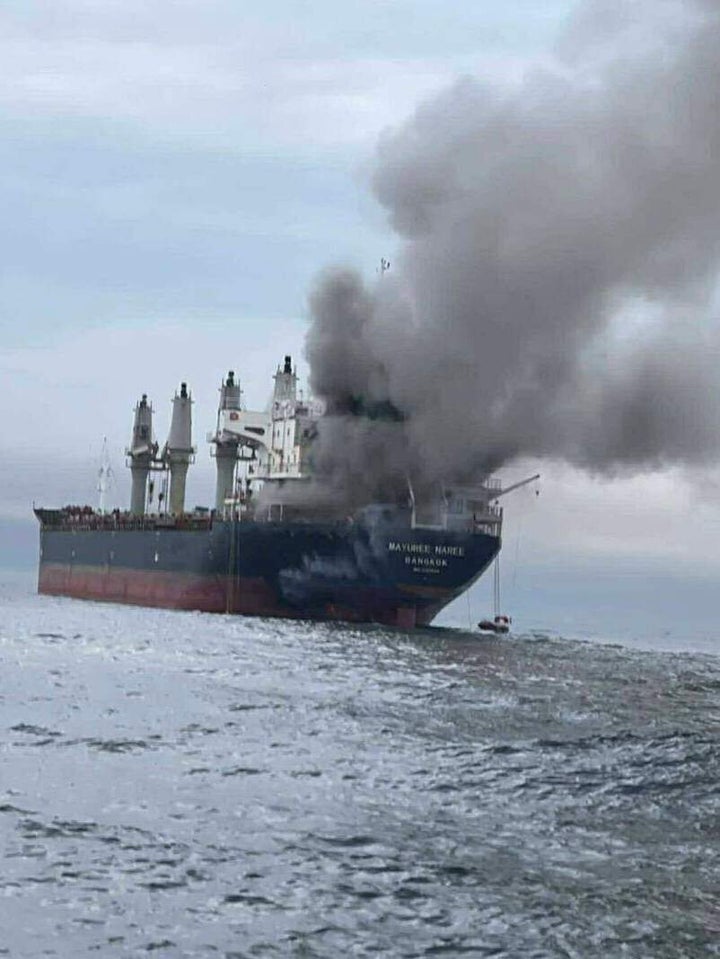
Royal Thai Navy via Associated Press
Iran has responded to U.S. and Israeli attacks by bombing the oil and gas infrastructure of U.S. allies in the region, further constraining supply, and closing the Strait of Hormuz, a chokepoint where 20-25% of the world’s oil flows through.
The Trump administration’s response to the sudden price shock also suggests they were caught flat-footed, at best.
In the span of just two hours on March 10 alone, crude oil futures fell more than 8% after Energy Secretary Chris Wright said the U.S. Navy had escorted a ship through the Strait of Hormuz, then rose nearly 5.5% after Wright deleted the social media post, then rose another 9.5% on news Iran might have placed mines in the Strait.
On March 11, Trump authorized the release of 172 million barrels from the Strategic Petroleum Reserve, which was only about 60% full when Trump decided to launch preemptive strikes. The action will take 120 days to deliver.
And on March 20, in a bid to drive down soaring oil prices, Treasury Secretary Scott Bessent rolled back sanctions on Iranian oil (yes, that’s the country we’re at war with), while just a week prior, the Treasury announced a similar action on Russian oil (which is at war with Ukraine, a U.S. ally).
Russia seized on the opportunity and immediately shipped oil to Cuba, in violation of a U.S. energy embargo of the island, where Trump is also itching for regime change.
Amid all the volatility ― and in no small part because of it ― major U.S. oil producers aren’t ramping up production, either.
“Market volatility and short-term price fluctuations create challenges for industry planning, which relies on stability to drive future investment,” Todd Staples, president of the Texas Oil and Gas Association, told Politico.
Data suggests high prices are here to stay for quite some time, said Justin Wolfers, an economics professor at the University of Michigan.
“It’s not just a blip,” Wolfers wrote on social media, alongside a graphic of West Texas Intermediate crude oil price futures through October 2029.
“Increasingly oil futures markets are suggesting that the Iran war is going to have (or has already had) effects that will last for years.”













.png)






.jpg)



 English (US) ·
  French (CA) ·