

 17 hours ago
1
17 hours ago
1
PROTECT YOUR DNA WITH QUANTUM TECHNOLOGY
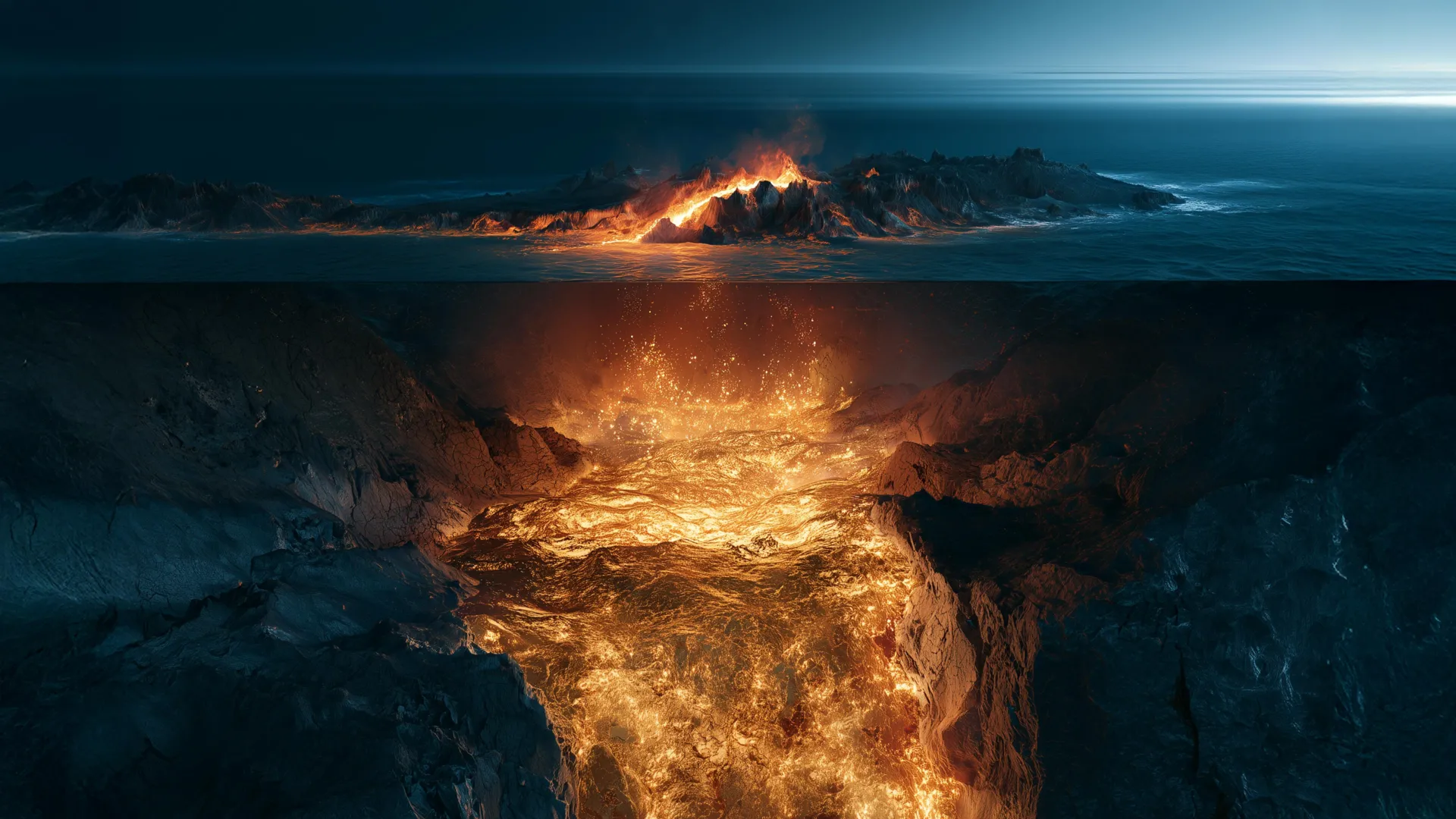
Orgo-Life the new way to the future Advertising by AdpathwayA vast reservoir of magma beneath Japan's Kikai caldera appears to be filling again, offering scientists a rare glimpse into how some of Earth's largest volcanoes recover after catastrophic eruptions.
The discovery, led by researchers at Kobe University, could improve understanding of enormous caldera systems such as Yellowstone in the United States and Toba in Indonesia. It may also help scientists identify the underground changes that occur before future giant eruptions.
A Volcano Capable of a Colossal Eruption
Kikai is a mostly submerged volcanic caldera south of Japan. About 7,300 years ago, it produced the largest known volcanic eruption of the Holocene, the current geological epoch, which began roughly 11,700 years ago.
Calderas form when an eruption empties such an enormous volume of magma that the ground above the reservoir collapses. Instead of leaving behind a typical cone-shaped mountain, the event creates a broad, relatively shallow depression.
The scale of these eruptions can be difficult to imagine. The amount of magma involved could cover all of Central Park to a depth of 12 kilometers.
Yellowstone, Toba, and Kikai are prominent examples of giant caldera volcanoes. Scientists know that these systems can erupt more than once, but the processes that allow them to accumulate vast quantities of magma remain poorly understood. That uncertainty makes their future behavior especially difficult to forecast.
"We must understand how such large quantities of magma can accumulate to understand how giant caldera eruptions occur," says Kobe University geophysicist Nobukazu Seama.
Listening to Seismic Waves Beneath the Ocean
Kikai's underwater location might seem like an obstacle, but it gave the research team an important advantage. Because much of the caldera lies beneath the sea, scientists could conduct broad and systematic surveys across the volcanic structure.
Seama explains, "The underwater location allows us to implement systematic, large-scale surveys."
The Kobe University team worked with the Japan Agency for Marine-Earth Science and Technology (JAMSTEC) to investigate the crust beneath the caldera. Researchers used airgun arrays to produce controlled seismic pulses and placed seismometers on the ocean floor to record how those waves traveled through the rock.
Seismic waves change speed and direction depending on the materials they pass through. By measuring those changes, scientists can build an image of underground structures and identify regions that may contain partially molten rock.
A Large Magma Reservoir Beneath Kikai
The findings, published in Communications Earth & Environment, revealed a substantial magma-rich region directly beneath the part of Kikai responsible for the enormous eruption 7,300 years ago.
The researchers were also able to estimate the reservoir's shape and extent. Its size and position indicate that it occupies the same underground system that supplied magma to the ancient eruption.
Seama says, "Due to its extent and location, it is clear that this is in fact the same magma reservoir as in the previous eruption."
That does not mean the magma has simply remained underground since the ancient disaster. Instead, the evidence suggests that new molten material has entered the reservoir over time.
Fresh Magma Is Rebuilding the System
A lava dome has been forming near the center of Kikai caldera for approximately 3,900 years. Lava domes develop when thick magma slowly rises to the surface and piles up around a volcanic opening rather than flowing easily away.
Chemical studies have shown that material from this dome and other recent volcanic activity differs from the magma released during the giant eruption. The contrast suggests that Kikai's current magma supply came from a newer source.
"This means that the magma that is now present in the magma reservoir under the lava dome is likely newly injected magma," summarizes Seama.
The findings support a broader model in which fresh magma gradually enters and rebuilds reservoirs beneath giant calderas after major eruptions. Understanding this process could reveal how these volcanoes begin preparing for later periods of activity.
Clues for Yellowstone and Toba
The proposed model may extend far beyond Kikai. Scientists have also identified large, shallow magma reservoirs beneath other major caldera systems, including Yellowstone and Toba.
"This magma re-injection model is consistent with the existence of large shallow magma reservoirs beneath other giant calderas like Yellowstone and Toba," says Seama.
By studying how quickly fresh magma enters these systems, where it accumulates, and how it changes the surrounding crust, researchers may eventually become better at distinguishing ordinary volcanic activity from signs of a much larger event.
Seama concludes, saying: "We want to refine the methods that have proved to be so useful in this study to more deeply understand the re-injection processes. Our ultimate goal is to become better able to monitor the crucial indicators of future giant eruptions."
The discovery does not mean that Kikai is about to erupt. Instead, it provides valuable evidence that the underground system responsible for its ancient catastrophe remains active and continues to receive new magma.
This research was funded by the Ministry of Education, Culture, Sports, Science and Technology (MEXT) (The Third Earthquake and Volcano Hazards Observation and Research Program (Earthquake and Volcano Hazard Reduction Research)) and the Japan Society for the Promotion of Science (grant 20H00199). It was conducted in collaboration with researchers from the Japan Agency for Marine-Earth Science and Technology (JAMSTEC).









.png)





.jpg)



 English (US) ·
  French (CA) ·