

PROTECT YOUR DNA WITH QUANTUM TECHNOLOGY
Orgo-Life the new way to the future Advertising by AdpathwayThe Pleiades star cluster is part of a much larger complex that stretches across the entire sky, a new study shows.

© NASA / ESA / AURA / CaltechThe Pleiades open star cluster.
Of all star clusters, the Pleiades are the most famous: Their brightest members, known as the Seven Sisters, are a delight to the naked eye. Look at them tonight, one hour after dark, right above the eastern horizon — but be aware that what you're seeing (and what early humans have painted on cave walls and mysterious Bronze Age disks) is just the tip of the iceberg: By combining data from different observatories, a team of astronomers has managed to identify more than 3,000 stars that formed together with the Pleiades but are now spread across nearly 2,000 light-years. They sprinkle the entire sky, with a notable concentration along the galactic plane.
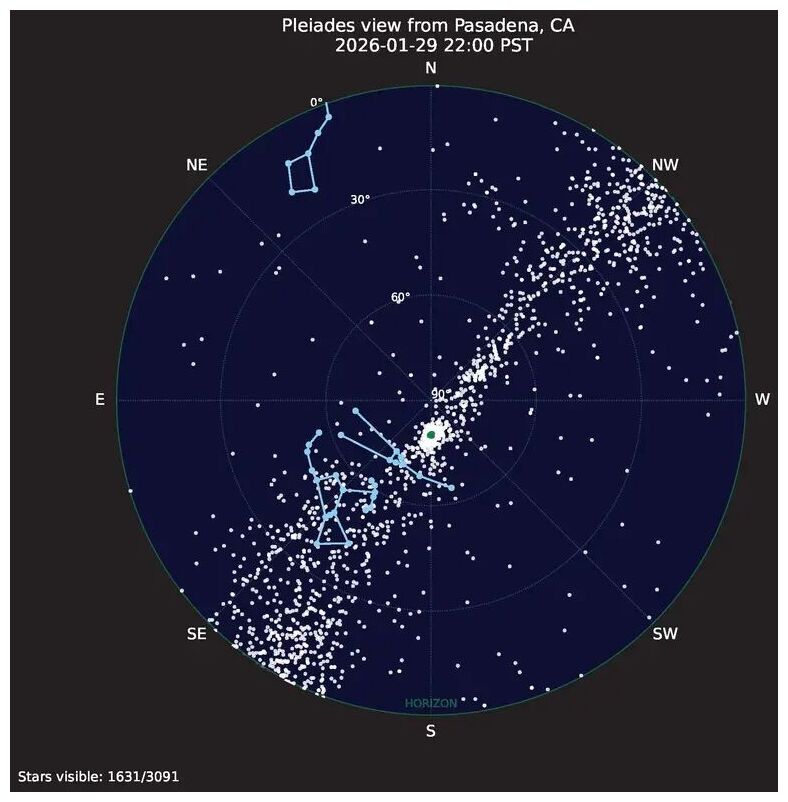
© Andrew Boyle / University of North Carolina Chapel HillThis starmap shows the full extent of the Greater Pleiades Complex as it would appear on the Pasadena night sky if every star in it were visible. Of the 3,019 stars that make up the complex, 1,631 are visible above the horizon. The seven stars that comprise the Pleiades, or Seven Sisters, constellation are shown in green while all the other members of the complex are in white. The Big Dipper, Orion, and Taurus are overlaid in blue.
"We are calling this the Greater Pleiades Complex," says Luke Bouma (Carnegie Institution for Science), who together with team lead Andrew Boyle and Andrew Mann (both University of North Carolina) published their findings in the November 20th Astrophysical Journal: "Most of the members of this structure originated in the same giant stellar nursery," he adds.
Open star clusters like the Pleiades are notorious for losing stars. They form in a single burst from a large cloud of gas and dust, but tidal forces start to tear them apart as soon as they're born. Astronomers think that after a few hundred million years, most open clusters have fully dissolved, their stars mixed unrecognizably with the rest of the Milky Way. (Open clusters' more compact and massive cousins, globular clusters, mostly manage to resist the tidal drag.)
The Pleiades, at approximately 440 light-years from Earth, are thought to have formed about 120 million years ago, so it's not surprising that some of its members are already spread across the galaxy. Astronomers already suspected that a few stellar groups within a few hundred light-years of the Pleiades are related to the cluster. Now, Boyle, Bouma, and Mann show that these groups indeed share similar motion, chemical abundances, and, most importantly, age with the Pleiades.
The team relied on data gathered by the European Space Agency's Gaia spacecraft during its mission from 2014 and early 2025. Among other things, Gaia measured precise 3D motions of about 880 million stars in the Milky Way. In 2021, a team led by Tereza Jeřábková (Masaryk University in Brno, Czech Republic) used this data to identify a 2,600-light-year-long[1] tail of stars originating from the Hyades cluster. The Hyades are located just 12° southeast of the Pleiades and are much closer to us (150 light-years) and older (about 600 million years) compared to the Seven Sisters. As a consequence, their stars are even more spread across the sky.
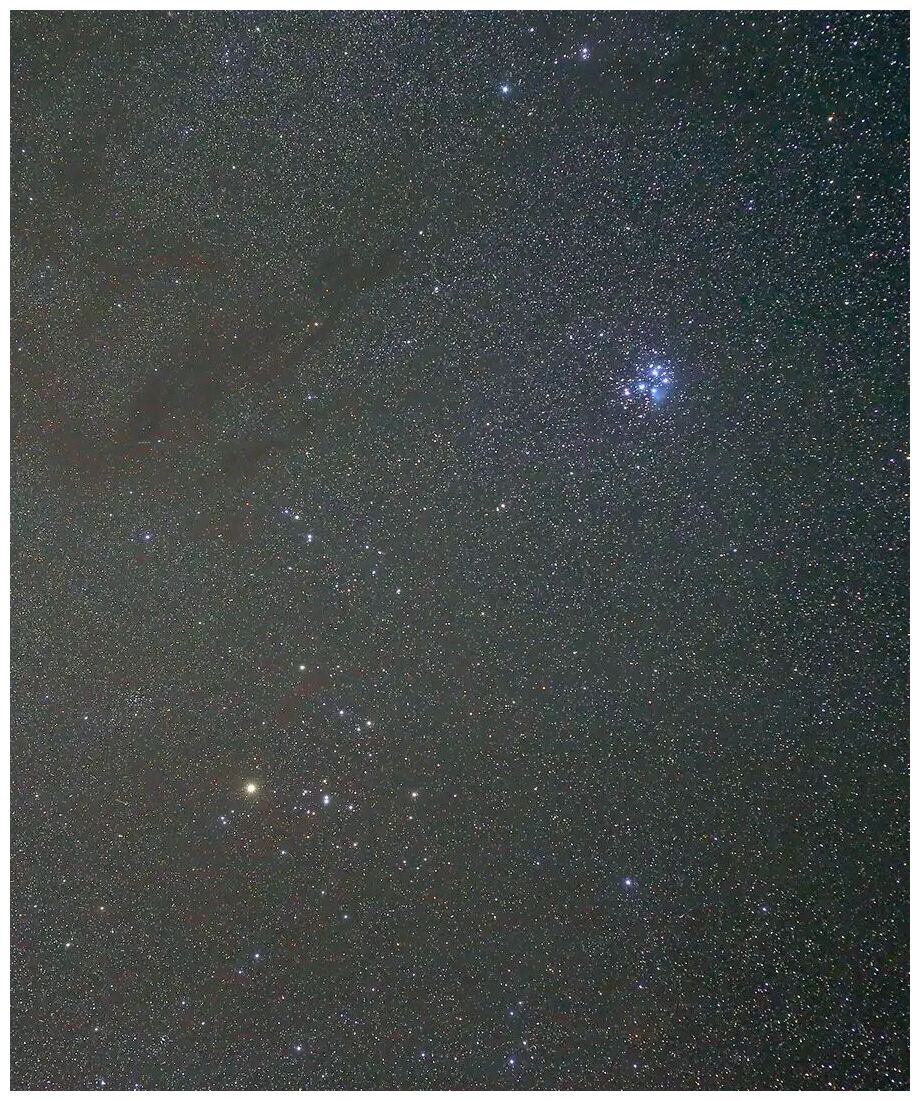
© Jan HattenbachThe Pleiades and Hyades clusters are pictured together in a wide-field image.
When Boyle, Bouma, and Mann looked at Gaia's data on suspected Pleiades-related groups, they realized that three of them were much closer to the cluster back when it was born. One group, called UPK 303, resembles a tidal tail; two others (HSC1964 and UPK 545) appear to have broken off from the cluster about 75 million years ago. Two more groups may also be associated to the Pleiades, but evidence for their relation is more ambiguous.
Stellar spectra gathered by Gaia, the Large Sky Area Multi-Object Fiber Spectroscopic Telescope (LAMOST) in Hebei province, China, and the Sloan Digital Sky Survey (SDSS) in New Mexico, show that these other stellar groups contain the same amount of heavy elements relative to hydrogen as the stars of the Pleiades do — as expected if they all formed out of the same gas cloud.
However, it wasn't until the ages of those stars became available that the researchers made their final conclusion. Gyrochronology, pioneered by Sydney Barnes (then University Wisconsin Madison), dates stars by the gradual slowing of their rotation as they age. That happens because stars' winds couple with their magnetic fields, taking away their spin in what is called magnetic braking. Gyrochronology has become a reliable way to determine the age of stars.
Boyle, Bouma, and Mann employed the technique on data from NASA's Transiting Exoplanet Survey Satellite (TESS). While originally designed to identify exoplanets that pass in front of their host stars, the mission has also provided rotation periods for many stars. The astronomers filtered out stars whose rotation periods, and thus ages, match the known age of the Pleiades: "It was only by combining data from Gaia, TESS, and SDSS that we were able to confidently identify new members of the Pleiades," Boyle says. "On their own, the data from each mission were insufficient to reveal the full extent of the structure."
"This is a very beautiful piece of work," comments Barnes, who was not part of the team. "[While] it was obvious to me in 2003 that gyrochronology would eventually allow the identification of populations of young stars in the galaxy, it was not clear then how unambiguous such population discrimination could become.""
Jeřábková also applauds her colleagues: "[They] provide an interesting and genuinely fresh view of the extended stellar populations associated with the Pleiades. By filtering candidates through gyrochronology, they significantly enhance the signal-to-noise ratio in the extremely diffuse, contamination-prone regime where Gaia alone is not sufficient."
The result shows that astronomers can trace the complex birth of open clusters over millions of years through to today, says Henri Boffin, (European Southern Observatory in Garching, Germany), who worked with Jeřábková. "It's an exciting development, and I expect it will stimulate many follow-up studies aimed at linking present-day phase-space structure to the initial conditions of star formation."









.png)






.jpg)



 English (US) ·
  French (CA) ·