

 3 months ago
23
3 months ago
23
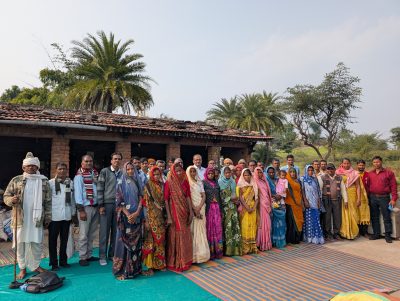
“Whenever we faced a family emergency, we had to borrow from private moneylenders at such high interest rates that it became difficult to emerge out of these debts. Sometimes the borrower ended up even losing his land.”
This is how Kamla recalled the old days before she and other rural women organized themselves in self-help groups. However the situation could improve significantly within a few years with the help of SHGs. As Kamla says,
“We are now not only able to meet our emergency needs on the basis of our own savings collected in SHGs, in addition we can tap our savings to improve our farming, such as by finding a new irrigation source, or starting various small and cottage scale enterprises which can become a modest but independent source of additional income for women and their households.”
Kamla and her friends like Soora take even more pride in the fact that they have been able to use these savings to help in the higher education of their children, not just sons but also daughters. Thus Kamla was able to arrange for the training of her two daughters as nurses while Soora supported the education of her daughter for becoming a teacher.
Kamla Devi is a leading member of various women-led initiatives in Suveri area of Kherawar block (district Udaipur) in South Rajasthan. These were started by a leading voluntary organization Seva Mandir (SM) first in the form of adult literacy classes and then in the form of SHGs. While SHGs improved the economic base of women, these also enabled women in many villages to take a more united stand against any incidents of violence or injustice against women. Such efforts acquired a more firm base with the establishment of a women resource center (WRC) around the year 2015, one of several such centers established over the course of a few years in South Rajasthan by SM. Since then the Suveri group has been taking up the resolution of various disputes and cases of injustice against women on a regular basis. As Kamla explained, the resolution process starts with the case being listed along with the payment of a modest fee. In many cases the dispute or the case can be resolved to the satisfaction of all concerned in just one or two hearings, but in more complex and contested cases these can continue for a longer period and sometimes mediation of more experienced persons at higher levels can be helpful.
.

.
Another useful role of the resource center that is becoming of increasing relevance for women, particularly women from weaker sections in more remote villages, is that of improving access to various government schemes. There are many kinds of government schemes of various benefits, pension schemes and medical care schemes but access to them depends on various documents being available in correctly updated form. Access to benefits may be denied even to most deserving beneficiaries if the documents are not available or if certain corrections and updating need to be made. Hence the help provided in this context to women from remote villages can be very important for them.
The resource center does not wait for women who need their help to reach them. If two members stay at the center, two others visit various villages regularly so that they can provide the necessary help to women right within their villages.
Similarly the efforts to reduce injustice against women are not confined just to resolving disputes or taking action when domestic or other violence against women has taken place. Instead efforts to raise social consciousness in various villages are made with continuity so that the possibilities of any violence or injustice against women can reduce significantly. Women here said that the overall incidence of violence against women has reduced significantly in these villages during the last decade or two.
However at the same time people say that some complex social problems, which cannot be simply described as injustice or violence, are also emerging in new forms, whether under the influence of social media or in other ways, which can ultimately result in a lot of distress, complications and uncertainty. Hence efforts to understand and to reduce these problems at an early stage need to be made and these are being initiated.
This is a region of many kinds of creative and promising developing activities being initiated by SM and its partner organizations. The growing unity, assertiveness and social space makes it possible for women to both contribute in more effective ways to these processes and efforts, and also to benefit from them. To give just one example, the work relating to pasture regeneration is particularly beneficial for women, while at the same time they have also made very important contribution to the success of these efforts.
*
Click the share button below to email/forward this article. Follow us on Instagram and X and subscribe to our Telegram Channel. Feel free to repost Global Research articles with proper attribution.
Bharat Dogra is Honorary Convener, Campaign to Save Earth Now. His recent books include Protecting Earth for Children, When the Two Streams Met, Navjeevan and A Day in 2071. He is a regular contributor to Asia-Pacific Research.
Global Research is a reader-funded media. We do not accept any funding from corporations or governments. Help us stay afloat. Click the image below to make a one-time or recurring donation.











.png)





.jpg)



 English (US) ·
  French (CA) ·