

.jpg) 6 hours ago
14
6 hours ago
14
PROTECT YOUR DNA WITH QUANTUM TECHNOLOGY
Orgo-Life the new way to the future Advertising by AdpathwayLong before climate breakdown entered mainstream political debate, Professor Herbert Girardet argued that economies dependent on relentlessly escalating resource use could never coexist comfortably with the planet’s ecological limits.
His work did more than criticise industrial civilisation. It tried to describe what a different relationship with the Earth might look like: human settlements organised around regeneration rather than depletion, economies compatible with ecological systems, and cultures striving to be ecologically literate.
Today, as environmental breakdown accelerates across continents, Herbert’s warnings feel less like predictions and more like descriptions of the world already happening around us. But his work continues to offer something increasingly rare: the belief that societies can still change course before ecological breakdown becomes irreversible.
DOWNLOAD THIS SPECIAL ISSUE (PDF)
Professor Girardet (known to friends and family as Herbie) is a cultural ecologist, author, and former filmmaker whose work helped shape global thinking on sustainability and urban ecology. He co-founded the World Future Council and served as a consultant to both UN Habitat and UNEP. In recognition of his contributions to environmental thought and practice, he received the UN Global 500 Award for Outstanding Environmental Services.
He’s a member of the Club of Rome, former chair of the Schumacher Society, UK, an Honorary Fellow of the Royal Institute of British Architects, a member of the Royal Academy of Arts and Sciences, a former patron of the Soil Association UK, and a visiting professor at the University of the West of England.
The ecology of civilisation
Modern industrial society was built on a dangerous assumption that nature exists primarily as a resource for human use. Forests became timber reserves, rivers became infrastructure, and soil became little more than a production unit for industrial agriculture. The language of economic growth concealed the damage, while extraction was framed as progress and prosperity.
For generations, the destruction beneath this system remained largely unaccounted for. Climate breakdown, collapsing biodiversity, polluted oceans and exhausted soils are no longer distant threats discussed only by scientists and activists. They are affecting ordinary life across the planet. Floods, fires, droughts and displacement increasingly define the political and ecological reality facing people in the twenty-first century.
Can we ever make technology work to enhance, rather than destroy life on Earth?
For more than fifty years, Herbert has returned to one central question: how can a civilisation organised around unlimited growth be reconciled with the reality of a finite planet? Drawing from ecology, systems thinking, urbanism and political economy, Herbert argued that cities and economies need to behave much like living organisms.
Their use of energy and materials needs to be compatible with the health of the systems supporting them. His central critique is that modern economies have become overwhelmingly linear, organised around extraction, consumption and waste at a scale the Earth can no longer absorb. He also warned that technological efficiency alone cannot prevent ecological collapse if societies continue consuming more resources each year.
Childhood in industrial Essen
The roots of Herbert’s ecological awareness lay in memory and lived experience. He was born in Essen in 1943, at the heart of Germany’s Ruhr Valley, one of Europe’s great industrial regions, where coal mines, steelworks and factories dominated both the physical landscape and the ideology of post-war reconstruction.
As Herbert later recalled: “I grew up on the outskirts of Essen, which is a major industrial location and was the main centre for weapons production for the Second World War, particularly companies like Krupp and Thyssen, [which] produced the guns and the tanks and so many other weapons that were used in the war”.
Some of his earliest memories are inseparable from smoke. From the family home he could see chimneys pouring thick clouds into the evening sky while the steel mills glowed red through the night. To many around him, this was simply what prosperity looked like. But even as a child, he found himself unsettled by what he saw.
“We could see the tall chimneys of factories spewing out black smoke. Every night we could see flames shooting off steelworks – it was an eery night. I can remember asking my father, where does all that smoke end up? What’s this going to do to the air that we breathe? But there was no answer to that question,” Herbert recalled.
The same feeling returned when his father bought the family’s first post-war car. “When my father started the engine and smoke came out of the exhaust pipe, I asked him, where does all that smoke go again? And again, you had no answer to that question”. Then came another formative experience: “And a few years later, we went down the river Ruhr, and there was a layer of sticky white foam on the river, and piles of dead fish in the river. I was asking, why are these fish dying? And again, there was no answer”.
Looking back, Herbert often remembered the silence surrounding those questions. Modern civilisation had become technologically sophisticated, remaining largely illiterate about the ecological consequences of its own behaviour. But his childhood wasn’t shaped only by vistas of smoke and pollution.
Alongside the industrial landscape were also gardens, orchards, forests and moments in nature where life followed entirely different rhythms. “I was always climbing trees, and I was out in the garden helping to grow vegetables, fruit and other crops”. That contrast between industrial extraction and natural regeneration would later become central to his understanding of civilisation itself.
Berlin and post-war politics
When Herbert moved to Berlin as a student during the early 1960’s, Europe was still wrestling with the political and moral aftermath of fascism and war. Berlin had become the symbolic centre of Cold War division, split between competing political systems and separated by walls, fences, checkpoints and ideological confrontation.
Across West Germany, younger generations increasingly refused to accept the silences surrounding the Nazi past and the moral evasions of post-war society. Universities became centres of political unrest. Anti-authoritarian movements spread across Europe and material reconstruction no longer seemed enough. A generation raised during industrial recovery began searching for alternatives both to Soviet authoritarianism and to the increasingly consumerist culture of Western capitalism.
Herbert found himself drawn into these wider debates. Although his father had hoped he would become an art historian, his interests veered towards politics, sociology and the broader question of how societies could recover from the catastrophe of war. Thinkers and activists such as Rudi Dutschke influenced many young Europeans searching for forms of social renewal capable of resisting both authoritarianism and the emptiness of purely material progress.
What interested Herbert wasn’t ideology for its own sake, but the possibility of cultural transformation. Europe had already demonstrated with terrifying clarity what industrial power could become when fused with nationalism, militarism and technological efficiency detached from ethical restraint.
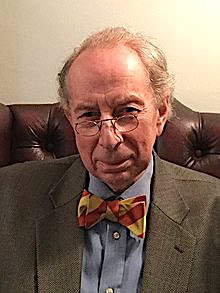
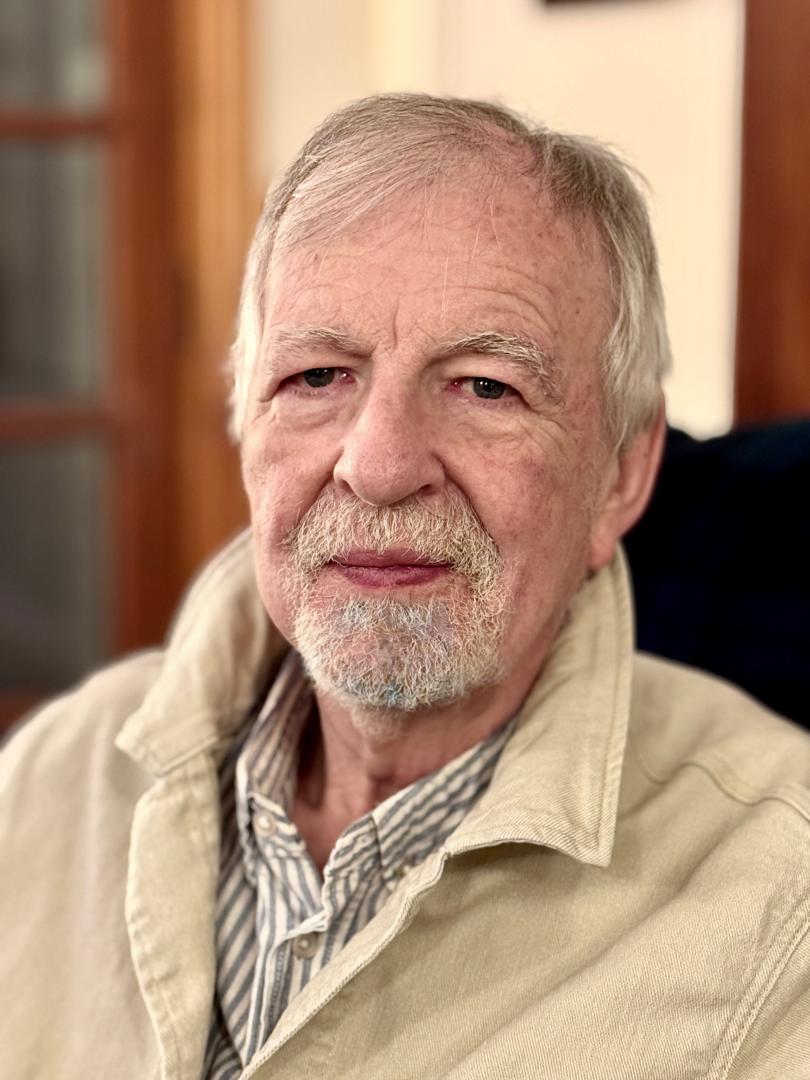 Professor Herbert Girardet (c) Professor Herbert Girardet
London community
That search eventually brought Herbert to London in 1965, at a moment when the city was being reshaped by migration, anti-racist struggle and cultural experimentation. London was unequal and politically volatile, but also alive with possibilities. Herbert rented a room in Notting Hill Gate, where communities from across the former British Empire were transforming the cultural life of the city. Herbert became involved in organising the budding Notting Hill Carnival, long before it became one of Britain’s defining cultural events.
At the time, it existed in open defiance of racism and hostility from far-right groups opposed to immigration. “I was one of the people involved in organising the Notting Hill Carnival, in the late 60s,” he later recalled, “so we had this wonderful experience of people from all these different backgrounds coming together with steel drums and other instruments, and dressed up in extraordinary costumes parading through the streets of Notting Hill Gate, and basically telling the fascists who were trying to stop the immigration to places like Notting Hill Gate: bugger off, we are going to determine what the future is going to hold rather than you... It was a very political time. And certainly, very creative and exciting”.
The experience reinforced something that remained central throughout his life: politics was shaped as much by ordinary communities as by governments and larger institutions. During these years, environmentalism began emerging alongside anti-war activism, feminism and anti-racist movements as part of a broader critique of industrial society and its values.
“The green movement was beginning to spring up in the late 60’s,” Herbert said. “Gradually the whole idea of creating a more egalitarian and more joyful world, that was also environmentally healthy, was gaining momentum. So, all of that was coming together in the minds of young people like us”.
For some years Herbert worked as a scriptwriter for the BBC German service while raising a family and remaining deeply involved in Notting Hill’s social life. His emerging ecological thinking remained grounded in ordinary questions about how people live together, what makes communities healthy and how societies define wellbeing beyond relentless economic accumulation.
His subsequent studies in social anthropology and economics at the London School of Economics deepened this perspective. “I went back to the LSE then, to study social anthropology, having met all these extraordinary people from all over the world who were living together in Notting Hill Gate. For me, that experience was a stimulus to try to understand where we come from, in terms of long-term human history,” he said.
For him, anthropology challenged one of the central assumptions of industrial modernity: the belief that Western economic development represented the natural endpoint of human progress. Through learning about a wide variety of cultures and cultural systems, Herbert encountered societies in which human beings understood themselves not as masters of nature, but as participants within larger ecological systems.
Documentary work
His subsequent work in filmmaking became another opportunity of exploring the environmental and social questions increasingly shaping his thinking. In the mid-1980s, Herbert and the late John Seymour got the unique opportunity to co-author Far From Paradise, a pioneering seven-hour BBC environmental TV series examining the history of humanity’s impact on the natural world.
In a 2004 memorial piece following Seymour’s death, Herbert reflected on the project and the environmental questions that shaped their work together: “In the mid-1980s, John and I spent three years making the BBC series and co-authoring the book Far From Paradise. This project took us to many parts of the world - the remnants of the ancient city of Ur and the salty wastes of Mesopotamia, the last remaining villages in Europe where people still farmed without tractors, the acid-rain-damaged forests of Germany, the eroding farmlands of Kansas and the skyscrapers of Manhattan. The first-hand evidence we collected of the ever-increasing impact of an industrialising, urbanising humanity on its host planet was a sobering experience for us both”.
Amazon and Indigenous knowledge
This understanding shaped Herbert’s later engagement with Indigenous cultures and ecological knowledge systems, particularly during his work in the Brazilian Amazon rainforest in the late 1980s while filming the documentary Jungle Pharmacy with the Kayapó people. The time he spent in the Amazon deepened ideas he had already been moving towards for years.
Forests were no longer to be viewed simply as sources of profit or raw materials, but as complex ecological communities shaped by generations of cultural, spiritual and environmental interaction. In other TV documentaries for Channel 4, Herbert portrayed the rapid destruction of the Amazon as mining, logging, industrial farming and road development pushed further into previously untouched areas. As global demand for resources intensified, the rainforest was increasingly seen solely for its economic potential: timber, cattle land, mineral deposits and transport routes, rather than as a complex and irreplaceable living system.
Indigenous communities defending their territories found themselves confronting powerful alliances between governments, corporations and global finance, all treating ecosystems and traditional cultures as obstacles to economic expansion. In his writings for Resurgence and The Ecologist, Herbert repeatedly returned to the Amazon because it revealed with exceptional clarity the ecological consequences of modern economic expansionism. Rather than romanticising Indigenous societies, he argued that industrial societies urgently needed to relearn key principles that many Indigenous cultures have preserved despite centuries of colonial violence: reciprocity, restraint and an understanding that human life depends upon ecological balance.
A deeply human perspective
For many years, The Ecologist has been one of the platforms where Herbert has shared his ideas about the environment and the future of society. His writing extends far beyond conventional environmental commentary. He explores the connections between climate change, pollution, overconsumption and their connections to economic and urban systems, arguing that these crises are deeply interconnected.
What distinguishes his work is its deeply human perspective. He rarely focuses solely on statistics or scientific warnings. Whether writing about cities, forests, oceans, farming or Indigenous knowledge, he consistently returns to the lived consequences of ecological destruction: how can we deal with damaged communities, polluted rivers, disappearing wildlife, exhausted land and the burden left for future generations.
In articles such as ‘Towards an Indigenous economics’, ‘Biosphere and technosphere’, ‘Reframing economics and Gaia, cyborgs and the memory industry’, Herbert questioned the belief that technology alone could solve environmental problems. The deeper issue, he argued, lay in linear economic systems that are currently organised around endless consumption and extraction.
His articles ‘Is nature taking revenge?’ and ‘A manifesto for the Coronacene’, further explored the connections between ecological destruction, globalisation and pandemic vulnerability. Covid, he argued, wasn’t an isolated crisis but part of a broader destabilisation caused by humanity’s interference in natural systems. Despite the seriousness of the crises he described, his writing rarely drifted into fatalism. At its core remained the belief that societies can still change course by choosing cooperation with nature rather than domination over it.
Herbert’s ideas also reached a wider international audience through his books, such as Earthrise, Cities People Planet, The Gaia Atlas of Cities, A Renewable World and Creating Regenerative Cities. Most of these have also appeared in foreign language editions, notably in Mandarin. These works explored how societies could build more balanced relationships with nature. Alongside his books and international policy work, Herbert also remains closely connected to the work of the Resurgence Trust. The magazine became one of the spaces where his ideas reach readers beyond governments, urban planners and environmental institutions.
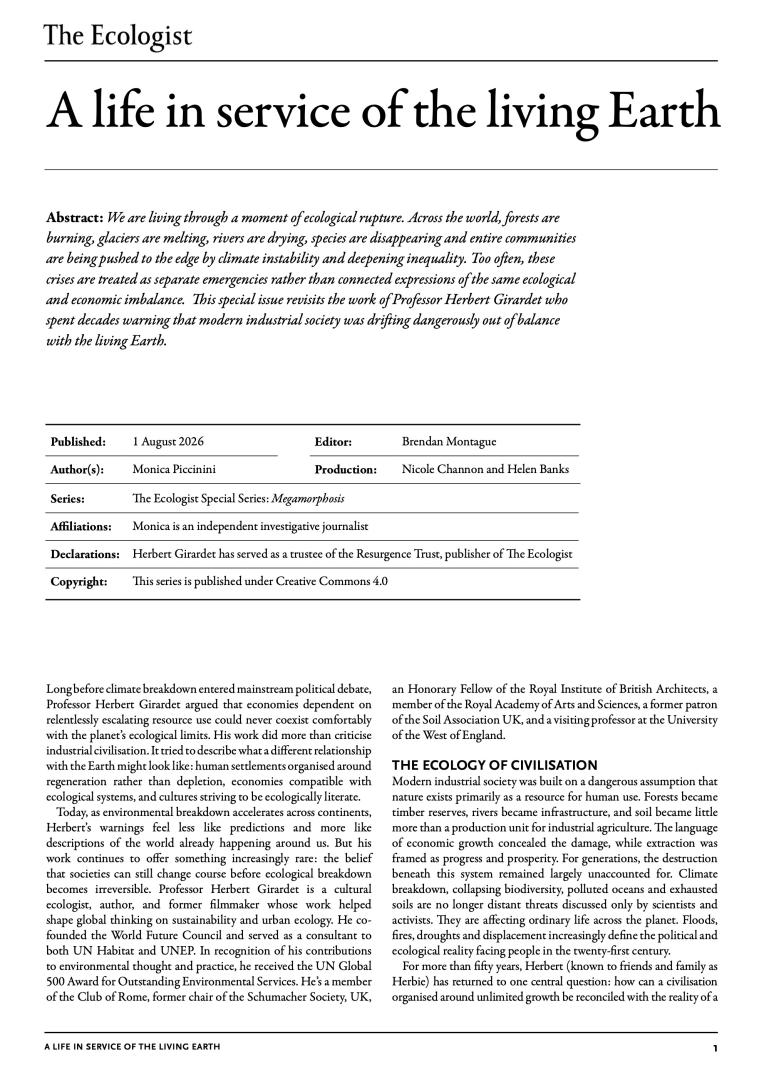 Download the PDF now.
Cities and ecological metabolism
Perhaps Herbert’s most influential contribution emerged through his work on cities and urbanisation. Cities fascinated him because they condensed many of the contradictions of industrial civilisation into concentrated form. They are centres of creativity, innovation and cultural exchange, but they also depend on immense flows of energy, food, water and raw materials imported from ecosystems often located thousands of miles away.
In his book Cities People Planet, he asked: “Can a world of ever-larger cities be environmentally sustainable? Can cities continue to prosper if they significantly decrease their use of resources? Can they mimic natural ecosystems and transform themselves into circular, not linear, systems? How can we create cities of physical beauty and social and cultural diversity that are also environmentally and economically sustainable? How can we restore the pulsing heart of conviviality to our cities?”.
Herbert’s interest in urban ecology began during his travels along the Amazon in the late 80’s, where he once saw a large freighter loaded with mahogany planks marked with a sign reading “London”. At the time, the connection between urban centres like London and distant ecosystems was not widely discussed.
This experience inspired him to study “London’s Metabolism”, which examined the hidden flows of food, fossil fuels, timber, water and industrial materials sustaining modern life. Modern cities appeared self-sustaining only because the ecological costs had been pushed elsewhere, into farmland, forests, rivers, oceans and distant supply chains rarely seen by urban populations.
For Herbert, the modern environmental crisis emerged from two worlds falling dangerously out of balance: the biosphere and the technosphere. In his book Earthrise, Herbert writes: “It was technology that gave us the capacity to acquire ‘Earth consciousness’. But it has also caused tremendous confusion in our minds, because that same technological power is actually separating us from our biological roots.
Having acquired the identity of both man and machine, we are suffering a conflict of allegiances. The human part of ourselves still follows the urge to reproduce and to love and care for our offspring as well as the living world from which we were born. But the machine part of us, which is supposed to be there to serve us, has no such preoccupations. “It is our task to find a mature and frugal use for the technologies we have harnessed. If they seem to have become our masters, then it is time to turn them into servants again. Can we ever make technology work to enhance, rather than destroy life on Earth?”.
Sustainable Adelaide
For Herbert, cities were never simply economic hubs. They were living systems, whose continuity is dependent on healthy relationships between people, resources and the natural world. In 2003, Herbert had a unique opportunity to put his ideas to the test: in Australia. He was invited to be Adelaide’s inaugural ‘Thinker in Residence’ under South Australian Premier, Mike Rann, and helped to shape a new environmental vision for the state, with a population of two million people, through his report, Creating a Sustainable Adelaide.
In March 2004, Mike Rann made this announcement: “Much of what Herbert proposed in his report after nine weeks of residency, studying the way our city region works, makes a lot of common sense. That’s why we are taking his advice and intend on running with his ideas. The more we can preserve and improve the environment in which we live, the better positioned we are in building a stronger economy and healthier society. These measures set a new pace of sustainable development and set important precedents for future decision makers”.
Most of his perspectives, particularly around renewable energy, water recycling, waste reduction, organic waste composting, urban reforestation, integrated urban planning and urban agriculture, have since been implemented. Long before “green cities” became a global political trend, Adelaide was already moving towards becoming one of the world’s leading examples of environmentally conscious urban regions, with record breaking supplies of renewable energy.
The limits to growth
Herbert’s long association with the Club of Rome reflects his concern that modern economies continue treating economic growth as an unquestionable objective despite mounting ecological evidence against it. The organisation’s influential 1972 report, Limits to Growth, warned that endless economic and population growth on a finite planet would eventually collide with ecological boundaries. In this respect, Herbert belongs to a wider lineage of ecological thinkers such as Lewis Mumford, Ivan Illich and E. F. Schumacher, all of whom understood environmental breakdown as inseparable from deeper crises within modernity itself.
Herbert’s environmental concerns eventually moved further beyond books and policy work into direct international action. At the 2002 UN Johannesburg Summit, he helped initiate the ‘Earth Emergency declaration’, a succinct statement signed by hundreds of environmental thinkers, scientists and campaigners who believed the world was entering a period of profound ecological instability. Rather than treating climate change, inequality, biodiversity loss and political failure as separate crises, the declaration argued they had to be addressed as deeply connected symptoms of a civilisation that had lost balance with the living Earth.
Regenerative thinking
Over time, Herbert became increasingly dissatisfied even with the language around sustainability itself. By the late twentieth century, sustainability had entered mainstream political discourse, yet it was often reduced to making industrial systems more efficient while leaving their underlying logic untouched.
Herbert therefore began focusing on ‘regeneration’. In a 2013 article in The Guardian, he said: “In my view, we need to start thinking of regenerative rather than just sustainable development. We urgently need to take specific measures to help regenerate soils, forests and watercourses rather than just allowing them to be sustained in an increasingly degraded condition as we have done for many years. We have the knowledge and the technologies to make renewable energy our main energy sources. And we urgently need to regenerate local communities and economies that have fallen by the wayside as economic globalisation has become the dominant force”.
Future generations
What gives Herbert’s work its enduring impact is the historical period it spans. He has lived through war, reconstruction, decolonisation, Cold War division, neoliberal globalisation and accelerating ecological destabilisation. His writing carries not only intellectual analysis but also historical memory, the perspective of someone who witnessed industrial modernity across multiple phases of expansion and crisis.
One concern appears repeatedly throughout his later work: the theft of ecological stability from future generations. “When you look around the world today, we are basically stealing our children’s future; doing that through all the activities, whether it’s rainforest destruction, whether it’s climate change, whether it’s biodiversity loss, whether it’s what we’re doing to the oceans, in terms of plastics, whether it’s all the other ways in which we are now consuming the planet,” he said.
This concern became central to his political engagement, including his role in co-founding the World Future Council (WFC) with Jakob von Uexküll in 2007. Future generations will inherit the consequences of political decisions made long before they can influence them. What can we do to get off their backs? “The idea was to help create a world fit for future generations. We were trying to find the best practices across sustainability and regenerative policies that could be replicated from country to country, city to city,” he explained. “Today, many young people are saying “enough is enough, we cannot accept that we don’t have a future!”. To my mind, this is the greatest power we have to generate change in the world,” said Herbert in an interview with Daniel Christian Wahl.
In 2008, Herbert and his WFC colleague, Miguel Mendonca, proposed that the UK government introduce the Feed-in Tariffs (FiT) scheme for accelerating the introduction of renewable energy. And so, it happened. Established under the Energy Act 2008 and officially launched on April 1, 2010, the scheme has enabled households, businesses, and communities to receive guaranteed payments for generating their own renewable electricity.
Legacy
Herbert spent much of his life challenging the assumption that endless industrial growth should define human progress. Many ideas once dismissed as unrealistic, including regenerative economies, circular systems and ecological city planning, have since entered mainstream political discussion, thanks in part to voices like his. But awareness alone changes very little.
Carbon emissions remain dangerously high, forests continue disappearing, biodiversity loss is accelerating. Despite the scale of the crisis, his work never collapsed into fatalism. He didn’t believe it was too late for societies to rethink their relationship with nature, with cities and with one another. Running through his work is the persistent belief that societies still possess the capacity to reorganise themselves around ecological restraint, reciprocity and collective wellbeing, whilst combining the concepts of adaptation, mitigation and regeneration.
Meanwhile, Herbert believes that we need a much clearer understanding of the vast unpaid bills we are passing on to future generations, that we need to define much more clearly what actual leverage we must bring about meaningful change. He suggests that a significant first step would be to create a new international ‘true cost’ alliance that quantifies these amounts sector by sector, and to confront decision-makers with the realities of their negligence. Looking across his life’s work, Herbert Girardet’s legacy feels like a quiet but persistent refusal, a refusal to accept ecological devastation as inevitable, a refusal to separate economics from ethics and, perhaps above all, a refusal to believe humanity is incapable of changing course.
This Author
Monica Piccinini is a Brazilian-British journalist and a member of the National Union of Journalists. She is a regular contributor to The Ecologist and publishes on Substack, Medium and on her own platform, YourVoiz.org. Professor Herbert Girardet, the subject of this essay, served as a trustee to the Resurgence Trust from March 2018 through to May 2026. Monica was given full editorial independence in writing this essay and received no payment from The Ecologist or from the Resurgence Trust for her work.
Afterword
Herbie writes: This essay about my work over 50 years came as a complete surprise. I'm not used to so much attention. I'm deeply indebted to Brendan Montague for initiating it, and to Monica Piccinini for putting so much care into writing it. I hope it will add to the extraordinary range of content presented on The Ecologist website since 1970.






.png)




.jpg)

 English (US) ·
  French (CA) ·