

 4 months ago
47
4 months ago
47

The U.S. government rarely bans political speech outright. Instead, it uses bureaucracy and procedure to make dissent too costly and dangerous to sustain. The goal is to exhaust and silence opposition without ever making it illegal.
Русский, Español, 中文, Portugues, Français, عربي, Hebrew, Deutsch, Farsi, Italiano, 日本語, 한국어, Türkçe, Српски. And 40 more languages.
What the state treats as intolerable is often mislabeled as “speech.” But it is political impact — the ability to mobilize people, challenge legitimacy, disrupt governance, or expose the violence sustaining the political order — that triggers state response. This is why the U.S. government repeats the same pattern of response to dissent across movements and decades: antiwar organizers undermine wartime discipline; Black liberation movements name racial governance and build power outside sanctioned channels; Puerto Rican independence activists turn colonial status into political crisis; Indigenous land defenders threaten resource extraction projects; post-9/11 Muslim civic leaders unsettle the moral architecture of the security state.
Palestinian advocacy is uniquely threatening because it targets the legitimacy of the U.S.–Israel governing order — a bipartisan foreign-policy pillar — by challenging its moral, legal, and strategic foundations from within the United States. By engaging directly with the threat frameworks used by federal law-enforcement and security agencies — many of them shaped through U.S.–Israel security cooperation — it activates a state response aimed at containment.
Most people reading about a federal response to political dissent never pause to ask how that response comes into being. Palestinians, by contrast, understand this process instinctively, because their political life in the United States has long unfolded under systems that convert their political dissent into “security” concerns and resistance into “risk” before authority even intervenes. The process begins when Palestinian political expression is translated into administrative concern by actors outside the state.
In Palestinian cases, this translation reliably moves through identifiable pressure points. Pro-Israel and Jewish advocacy organizations monitor campus activism and circulate names, dossiers, and allegations. Politically connected alumni and donors pressure university administrators and federal officials to intervene. Members of Congress and their staff — often those publicly committed to defending Israel from political challenge and to expanding antisemitism frameworks — amplify these allegations through letters, hearings, and coordinated media appearances. Executive-branch officials, operating within a foreign-policy apparatus structured around protection of the U.S.–Israel alliance, then reframe Palestinian organizing as a foreign-policy or national-security concern. By the time federal authority acts, these political challenges have already been stripped of argument and recoded as administrative problems the state is equipped to manage.
When the target is a noncitizen or legally vulnerable resident, the government reaches for immigration law — as it did in earlier cases involving Palestinian organizers such as Rasmieh Odeh (deported in 2017 after a prolonged legal battle over her activism) and the LA Eight (Palestinian activists prosecuted in the 1980s–90s), and as it does now in Mahmoud Khalil’s case, a Columbia University master’s graduate arrested and detained under immigration law on March 8, 2025, after his leadership activity in pro-Palestinian campus protests.
Immigration law gives the government a way to act quietly and decisively. People can be detained without being convicted of anything, courts have limited power to intervene, and deportation is treated as an administrative matter. Political activity is never named as the reason, but it is often the reason enforcement begins.
When immigration law is unavailable — because the target is a U.S. citizen or otherwise cannot be removed — the state does not abandon containment. It changes instruments. Instead of using border or status rules, it relies on criminal investigations, national-security claims, and prosecutorial discretion — areas of law that allow authorities to disrupt political organizing without ever charging anyone for their speech.
This is how the FBI’s COINTELPRO program operated against the Black Panther Party and Martin Luther King Jr. The government treated political organizing as a security threat, using surveillance, informants, arrests, and smear campaigns to weaken and divide movements, even though their ideas were never made illegal.
.
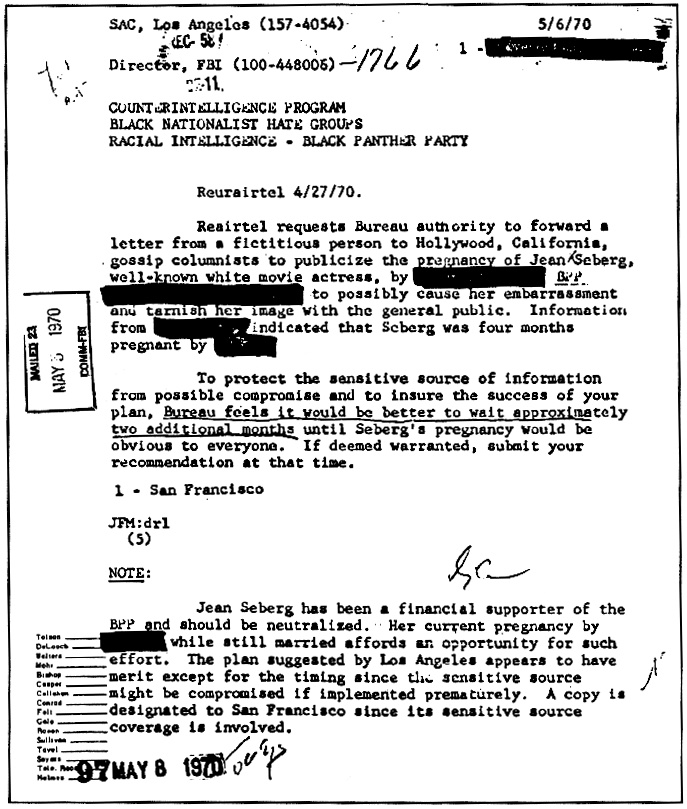
COINTELPRO memo proposing a plan to expose the pregnancy of actress Jean Seberg, a financial supporter of the Black Panther Party, hoping to “possibly cause her embarrassment or tarnish her image with the general public”. Covert campaigns to publicly discredit activists and destroy their interpersonal relationships were a common tactic used by COINTELPRO agents. (Public Domain)
.
In these situations, prosecutors and investigators do not say that a person’s political beliefs are unacceptable. Instead, they build cases around who someone knows, works with, or is connected to, treating ordinary political relationships as signs of danger or wrongdoing.
They open investigations that can last for years, convene grand juries, or launch “material support” inquiries that may never lead to charges but still drain time, money, and energy from individuals and organizations. Secrecy rules and classified claims limit the ability to challenge the government’s case, while surveillance and informants are used to create fear, mistrust, and division inside political groups.
At the same time, selective leaks and public accusations damage reputations and discourage people from getting involved, even when no charges are ever filed.
The U.S. government does not discipline speech in the abstract. It targets the networks that allow dissent to function — organizers, student groups, institutions, and funding channels — by acting through procedure rather than principle. By routing cases into legal forums — most notably immigration court, where executive foreign-policy certifications are treated as sufficient and constitutional claims are deferred until after detention and removal proceedings have moved forward — the government can impose detention, disruption, and reputational harm while presenting the outcome as neutral rule enforcement.
Mahmoud Khalil’s case follows this roadmap with unusual clarity. Pro-Israel advocacy organizations, politically connected donors, and aligned Members of Congress publicly targeted him for his leadership in campus protests against the Gaza war, framing his speech and organizing as extremist and destabilizing.
That pressure — generated by organized pro-Israel advocacy organizations and aligned Jewish communal institutions — moved through congressional letters, hearings, and coordinated media appearances and entered federal channels already classified as a policy threat rather than a political dispute.
The Secretary of State then made the system’s first decisive move, translating Khalil’s advocacy into a foreign-policy risk by asserting that “the Secretary of State has reasonable ground to believe that [Khalil’s] presence or activities in the United States would have potentially serious adverse foreign-policy consequences.” The certification did not rebut Khalil’s speech; it set the executive branch’s governing frame, placing the matter under executive control rather than public political debate or immediate judicial review, and authorizing enforcement by agencies such as the State Department and the Department of Homeland Security under powers delegated by Congress.
The Department of Homeland Security acted on that reclassification, arresting and detaining Khalil under immigration law and taking physical control of him before any court could address the First Amendment implications. DHS routed the case into immigration court, where judges must accept executive foreign-policy certifications and cannot order discovery into government motive. This routing insulated the government’s decision to detain Khalil for his political advocacy from judicial scrutiny.
Image: Activist Mahmoud Khalil (Public Domain)

A federal district judge briefly interrupted that sequence. On May 28, 2025, Judge Michael E. Farbiarz ruled that the foreign-policy basis for Mahmoud Khalil’s detention is likely unconstitutional, finding that the “foreign-policy grounds on which Mahmoud Khalil was detained … are likely unconstitutional,” describing the government’s reliance on the provision as “unprecedented.” The ruling mattered because it forced into view what the state had kept procedural: the use of executive discretion to punish political advocacy.
Rather than defend the foreign-policy claim on the merits, the government shifted terrain. Its lawyers layered additional administrative charges — alleged misrepresentation and paperwork violations — to widen the neutrality frame and recast the case as routine enforcement rather than viewpoint retaliation. Khalil’s counsel responded plainly: he was “unlawfully detained … because of his pro-Palestine advocacy at Columbia University.” The two sides spoke in different registers — one naming political motive, the other multiplying administrative predicates.
The final government move completed the sequence by delaying full court review. The Department of Justice argued that no federal court could consider Khalil’s constitutional claims until he had gone through the entire immigration process. On January 15, 2026, in a 2–1 ruling, the Third Circuit accepted that argument and reversed the release order, holding that the district court lacked jurisdiction because Khalil had not exhausted immigration proceedings. The majority decided the case on procedural grounds, not on the First Amendment.
In dissent, Judge Arianna J. Freeman named the consequence without hedging: “The government does not challenge the finding that Khalil’s speech was being chilled,” yet the court treated the injury as remediable later — even though such harm “cannot be remedied after the fact.” Delay had become enforcement.
Khalil’s case shows how the U.S. government avoids public debate by removing advocates from universities, community networks, and public life — spaces where political speech can mobilize support and challenge policy — while preserving the outward form of constitutional legality.
The case points beyond one person’s status to a governing style in which U.S. officials treat political dissent as a management problem. Palestinian advocacy is redirected into institutional compliance systems — university conduct rules, antisemitism frameworks, funding requirements, immigration conditions, and foreign-policy expectations — where administrative controls contain it without addressing the political claims at stake.
This mirrors the U.S.-Israel approach to Palestine itself. Washington administers the conflict through security coordination, military aid, diplomatic shielding, and process language that contains Palestinian political claims while deferring settlement, rights, and accountability.
Administrative power determines which politics can endure.
The task, then, is not only to defend speech in the abstract, but to name and contest the administrative systems that determine which political advocacy is permitted to circulate, which is reclassified as a security or compliance risk, and which is suppressed through administrative cost and delay.
*
Click the share button below to email/forward this article. Follow us on Instagram and X and subscribe to our Telegram Channel. Feel free to repost Global Research articles with proper attribution.
Rima Najjar is a Palestinian whose father’s side of the family comes from the forcibly depopulated village of Lifta on the western outskirts of Jerusalem and whose mother’s side of the family is from Ijzim, south of Haifa. She is an activist, researcher, and retired professor of English literature, Al-Quds University, occupied West Bank. Visit the author’s blog.
She is a Research Associate of the Centre for Research on Globalization (CRG).
Featured image is from the author
Global Research is a reader-funded media. We do not accept any funding from corporations or governments. Help us stay afloat. Click the image below to make a one-time or recurring donation.










.png)


.jpg)


 English (US) ·
  French (CA) ·