

 4 months ago
46
4 months ago
46

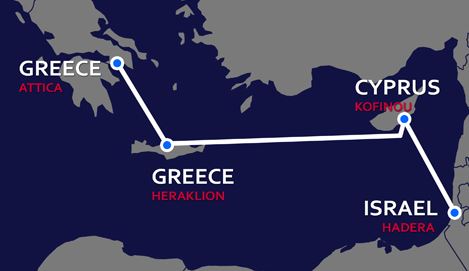
The regulation (H.R. 3307 – Eastern Mediterranean Gateway Act), which was recently voted in the US Congress and aims to institutionalize defense, energy and security cooperation between Greece, the Greek Cypriot Administration of Southern Cyprus and Israel in the Eastern Mediterranean, shows that the alliance architecture in the region is no longer a temporary coordination, but a permanent and multi-layered strategic structure. With this arrangement, the Eastern Mediterranean is defined by Washington not only as an energy basin, but also as a geopolitical area directly linked to the regional security priorities of the USA.
Türkçe, Русский, Español, 中文, Portugues, Français, عربي, Hebrew, Deutsch, Farsi, Italiano, 日本語, 한국어, Српски. And 40 more languages.
The US Wants the Seville Map in the Eastern Mediterranean
Greece and the Greek Cypriot Administration have military infrastructures. Israel, with its advanced technology and intelligence capacity, is positioned against Türkiye as complementary elements of this architecture.
Maritime security, joint exercises, air and missile defense, protection of energy transmission lines and political arbitration of maritime jurisdiction areas are now handled within the same framework, so that Greek-Cypriot and Greek-Israeli cooperation is turning from a covert regional grouping aimed at balancing Türkiye into an open strategic axis that has gained legitimacy in the eyes of the US Congress.
This picture clearly reveals why the discomfort with the Blue Homeland doctrine, which is a kind of manifesto of Türkiye, which was squeezed ashore through the Seville Map supported by the EU and the USA, is expressed not only in Athens but also on the legislative ground in Washington. We can say that this process took almost seven years. The point to be noted here is that the congress arrangement in question functions as a “geopolitical vision” for the future rather than just a technical framework that responds to current security needs.
Every structure institutionalized through the US Congress aims to freeze regional balances over time, label the objecting actors as non-system and problematic, and finally antagonize them unless geopolitical concessions are made. The Blue Homeland doctrine has been met with a systematic reaction in the USA since the day it emerged, despite the US/EU/Israel-backed FETÖ (Gulenists) plots and purges established in the Turkish army and navy after 2008. This reaction is aimed at Türkiye’s questioning of the unreasonable maritime jurisdiction sharing claim shaped on the Western-centered Seville map in the Eastern Mediterranean and the Aegean, rather than increasing its naval capabilities in the seas. The main discomfort in Washington is Türkiye’s de facto and mental rejection of the map in question and its refusal to define maritime jurisdiction areas according to this map. In fact, what is happening is the rejection of the Sèvres map, which was rejected 106 years ago, by its equal in the sea today.
For this reason alone, US think tanks and policy circles often describe the Blue Homeland as an “aggressive”, “revisionist” and “contrary to international law” doctrine due to their narrative. The common emphasis in the analyzes of CIMSEC, Brookings and similar institutions is the claim that Türkiye acts out of the imposition of power, not from the search for a conciliatory law at sea. According to these circles, the Blue Homeland is a strategy that constantly produces crises in the Aegean and Eastern Mediterranean and disrupts the existing balance established in favor of Greece and the Greek Cypriot Administration. In these discourses, law is mostly discussed through the United Nations Convention on the Law of the Sea (UNCLOS) and its interpretations in favor of the West; Türkiye’s non-party to the convention is presented as an indication of “illegality“.
However, the real problem for the USA, which has not signed UNCLOS like Türkiye and Israel, is not Türkiye’s law, but Türkiye’s opposition to the will of the USA and the EU. Criticisms directed at the Blue Homeland are therefore systemic, not technical or legal. The general expectation in Washington is that Türkiye will come to a position that does not object to the energy and security architecture of the Greece-Greek Cyprus-Israel axis in the Eastern Mediterranean, tacitly accepts the Seville Map and accepts the role of a secondary actor in the sea. The Blue Homeland, on the other hand, draws reaction in the USA precisely because it disappoints this expectation. This doctrine has transformed Türkiye from a country that only objects to an actor that exists on the ground and redefines the balance. In other words, the discourse developed against the Blue Homeland in the USA is that they are not very satisfied with what Türkiye is doing. This opposition is not so much a maritime law dispute as a matter of who will draw a map in the Eastern Mediterranean.

FDD Panel Held in the USA and the Greek Minister
On February 4, 2026, FDD (Foundation for Defense of Democracies), a hard-line Israeli-backed think tank working in close contact with the security and foreign policy decision-making processes of the United States, held a panel in Washington DC. It was no coincidence that the panel titled “Reimagining Mediterranean Security with Greek Minister for National Defense Nikos Dendias“ was organized by the FDD, which is ideologically very close to the neocons and pro-Israel (Zionist security perspective). FDD is part of a “threat identification“ and “prioritization“ mechanism rather than an academic platform that produces analyses that center on US interests, especially on the Middle East, Eastern Mediterranean, Iran, Israeli security and great power competition, and provides direct policy frameworks to Congress, the Pentagon and intelligence circles. For this reason, FDD panels are not open academic environments where debates are held in the classical sense, but environments where it is analyzed which actor is a threat, which policy is legitimate, and which doctrine should be limited. The language used here is often harsher, more naked and more directive than the official discourse of states. The Greek Defense Minister’s preference for this platform is an indication of his desire to engrave his message directly on the mind maps of US decision-makers.
FDD’s Financing Structure and Perception of Türkiye
This structure is largely funded by private donors and foundations based in the USA. Public information indicates that FDD’s primary supporters include private foundations and family funds that prioritize Israeli security and harsh anti-Iran policies. Due to this pro-Israel structure of global finance capital supporters, FDD has considered Türkiye as an actor acting autonomously within NATO in recent years and challenging the Western-centered status quo. For this reason, it approaches sea-centered Turkish doctrines such as the Blue Homeland with special interest and distance. The common feature of these donors is that they support a strategic approach in US foreign policy that prioritizes Israeli security and legitimizes the use of anti-Iran and hard power. In this context, the Blue Homeland is not only an approach to Türkiye’s maritime jurisdiction areas; it is also perceived as a factor that narrows the free movement area of the US-Israel-centered security architecture in the Eastern Mediterranean. Türkiye’s presence as a permanent and continuous power in the seas, especially in the Eastern Mediterranean, in short, its maritimization turns into a structural problem that needs to be controlled in terms of these circles. Therefore, the criticisms directed at the Blue Homeland are the product of a systematic policy and geopolitical reflex rather than legal or technical.
Bringing the Blue Homeland to the Global Agenda
Greek Defense Minister Dendias’s long speech at the panel means much more than a diplomatic statement. This speech is a clear example of the attempt to bring it to a systematic global agenda and erode legitimacy against the Blue Homeland doctrine. What is remarkable is that Greece did not express this discomfort in Athens or Brussels, but directly in Washington and in front of the American establishment. This choice shows that the issue is intended to be moved from a Greece-Türkiye problem to a US-centered security and order debate.
According to Dendias, the Blue Homeland is a trap for the Turkish people.
In the narrative of the Greek Minister of Defense, the Blue Homeland is presented as a “new, dangerous, ideological, neo-Ottomanist and contrary to international law” project. In the conversation, he says:
“Yes. This doctrine did not exist 10-15 years ago. What is called the ‘Blue Homeland’… I remember the first time I saw this Blue Homeland map behind their Presidents when he was addressing the cadets of the Naval Academy when I was the Minister of Foreign Affairs. I called a Turkish friend and asked, ‘What is this?’ Would you believe it, he said to me, ‘He doesn’t know what it is either’. At that time, the Blue Homeland was a very new approach. Within two or three years, it became the official doctrine of the Turkish state. Now it is said that it is taught in Turkish schools. But I am afraid that this is a trap for all of us, especially for Turkish society.”

Would you look at the arrogance? It is an approach that is so far from reason and logic that it says that the Blue Homeland, which wants to protect the rights of the Turkish people in the seas, is a trap for the Turkish people.
Dendias‘s narrative is deliberately incomplete and guiding. Because the Blue Homeland is not an expansion ideology for Türkiye, but a belated strategic awareness that reminds us that the sea is an area of sovereignty. Considering that Türkiye has been forced to see the seas as a secondary and even problematic area for nearly a century, the Blue Homeland is not a leap, but a move to reclaim. This move is not an ideological defense of the mistakes or negligence made in the past, but an acceptance by the state of the geopolitical necessity imposed by the region. While it is normal for a country surrounded by seas on three sides to center the sea, the fact that this orientation is presented with the label of “expansionism” when it comes to Türkiye clearly shows that the issue is political, not technical.
Greek Governments, especially in the Aegean after 1955 they always wanted “more seas, more Aegean, more Mediterranean” in the Eastern Mediterranean. And they presented this as the status quo against Türkiye and the world. When Türkiye objected to the continental shelf, territorial waters, islands and rocks like Kardak (EGAYDAAK) and the Seville map in the Eastern Mediterranean and the Greek Cypriot Administration fait accompli’s, they accused Türkiye of being a country trying to force the change of the basic balances in the Aegean with crisis and pressure. According to people like Dendias, the status quo is seen as accepting the impositions of the Seville map in the Aegean and Mediterranean, which pushed Türkiye to the coast, continuing the continental shelf problem that has been frozen in the Aegean since 1976; keeping the airspace at 10 miles; arming the islands with non-military status, or not bringing up the issue of islands, islets and rocks with disputed sovereignty that emerged with the Kardak Crisis.
The most striking point in the speech is the emphasis on the difference in mentality rather than maps or technical maritime law details. While the Minister of Defense proposes to ask the USA and Türkiye about the picture of the Eastern Mediterranean 10-20 years later. In the question, “After 10 years, would the Mediterranean under the influence of Israel and Greece or the Eastern Mediterranean in Türkiye’s sphere of influence be preferred for the USA?” This question is more of a confession than a complaint. What is disturbing is not the borders drawn by Türkiye, but the way Türkiye looks at the sea. In short, a maritime Türkiye is not wanted.
Legal Discourse, Status Quo and Power Struggle
This is where the problem for Greece begins. The status quo order, which assumes that it can control almost the entire sea through dozens of islands, islets and rocks in the Aegean and Eastern Mediterranean, or that it will almost exclude Türkiye from the Mediterranean despite the huge Anatolian peninsula through Crete, Meis and the Greek Cypriot Administration, has become questionable with the Blue Homeland. This questioning stems not only from Türkiye’s military capability, but also from Türkiye’s repositioning of the navy as a geopolitical tool of reason and continuity. For this reason, although the issue is presented as a technical law discussion, it is essentially a matter of power and order.
The Minister of Defense’s constant reference to the United Nations Convention on the Law of the Sea while declaring the Blue Homeland “contrary to international law“ should also be read in this context. Because here, law is used not as an impartial set of norms, but as a shield that protects the existing distribution of power. The fact that Türkiye is not a party to this convention, just like the USA and Israel, is presented by Greece as a crime of law; however, the real problem is not Türkiye’s rejection of the law, but the frozen interpretation of the law in favor of Greece. At this point, the link between the instrumentalization of law and the maintenance of the balance of power becomes clear.
International law is not a system of norms independent of power relations on the ground. On the contrary, it often functions as a framework that supports existing balances. Türkiye’s questioning of this framework is not an act of lawlessness, but a demand for the reopening of a frozen order to negotiation. It is no coincidence that the Cyprus issue occupies a central place in the conversation. Greece and Israel feel the harshest reflections of the Blue Homeland around Cyprus. Türkiye’s active and permanent naval power off the coast of Cyprus from time to time has radically affected the energy, security and alliance equations established in the Eastern Mediterranean. For this reason, Cyprus and its surroundings are presented as the most visible stage of Türkiye’s presence at sea in the Greek, Greek Cypriot and Israeli claims.
Conclusion: The Systemic Disturbance Created by the Blue Homeland
In the following parts of the speech, Greece’s defense cooperation with Israel, joint maritime patrols and multi-layered air defense projects are brought to the agenda. The message given at this point is clear. Although Türkiye does not seem to be directly targeted, a deterrent architecture is being built against Türkiye. This situation is not due to Greece’s own military capacity; It also reveals the search for balance with a wider alliance and patronage network. The call to Washington is also an expression of Athens’ fear of strategic isolation.
In my Substack article (Turkiye’s Kardak Intervention) dated February 2, 2026, I wrote that former Greek Deputy Foreign Minister Valinakis also saw this situation. Giannis Valinakis, who served as Deputy Minister of Foreign Affairs of Greece between 2004 and 2009 and currently serves as the President of the Jean Monnet European Center of Excellence at the University of Athens, said the following during an interview on a Greek TV channel on January 8, 2026:
“I think NATO will no longer provide any guarantee to Greece. Greece’s security environment is deteriorating. NATO is under serious pressure, and this pressure comes primarily from the Americans. In fact, it is being discussed whether NATO will survive in the long term… Article 5, that is, support for an ally that has been attacked, is now getting weaker with Trump’s words. Europe is also weakening within itself. Although it seems that we are trying to understand the extent of the risks and adapt to the changes of the period, instead of a Europe where 27 countries are listened to one by one, we can now move towards a Europe where 3 or 4 leaders direct their power and the others follow them.”
Dendias’s speech also supports the loneliness concern emphasized by Valinakis here, but it also goes further and reflects Greece’s fear of the Blue Homeland. This fear is not that Türkiye will one day start a war, but that Türkiye has established itself as a permanent, permanent and legitimate power at sea. The Greek Defense Minister’s complaint about the Blue Homeland to the USA is the clearest indication that Türkiye’s strategic mind in the seas has started to disturb not only Athens but also the Washington-centered order.
*
Click the share button below to email/forward this article. Follow us on Instagram and X and subscribe to our Telegram Channel. Feel free to repost Global Research articles with proper attribution.
This article was originally published on Mavi Vatan.
Ret Admiral Cem Gürdeniz, Writer, Geopolitical Expert, Theorist and creator of the Turkish Bluehomeland (Mavi Vatan) doctrine. He served as the Chief of Strategy Department and then the head of Plans and Policy Division in Turkish Naval Forces Headquarters. As his combat duties, he has served as the commander of Amphibious Ships Group and Mine Fleet between 2007 and 2009. He retired in 2012. He established Hamit Naci Blue Homeland Foundation in 2021. He has published numerous books on geopolitics, maritime strategy, maritime history and maritime culture. He is also a honorary member of ATASAM.
He is a Research Associate of the Centre for Research on Globalization (CRG).
Featured image is from the author
Global Research is a reader-funded media. We do not accept any funding from corporations or governments. Help us stay afloat. Click the image below to make a one-time or recurring donation.











.png)






.jpg)



 English (US) ·
  French (CA) ·