

 2 months ago
36
2 months ago
36
PROTECT YOUR DNA WITH QUANTUM TECHNOLOGY
Orgo-Life the new way to the future Advertising by AdpathwayThe Son of God did not bring salvation and redemption to our fallen world through His signs, wonders, or words, but rather, by willingly experiencing an incomprehensibly violent death in the most virile manner, overcoming it at His Resurrection. Jesus gave up His life that the Body of Christ, the Church, would live (Ephesians 5:25) as the chosen vessel of the salvation He won until He returns. His Church was conceived at the Cross as the precious Blood and Water gushed forth from His most Sacred Heart, which also became the supernatural source of its sacraments. Relatedly, the Divine Mercy of God poured out for all the world not through passive prayer or pious works but by the razor-sharp tip of an iron spear forcefully thrust by a masculine, militant, man of war and violence between the fifth and sixth ribs of the Savior of the World, piercing His most Sacred Heart.
This means that God’s perfect, providential plan of salvation was not accomplished through passivity or piety but in the most masculine manner by His Son who took on flesh in order to sacrifice it, even pouring out the final drops of His Blood in the most humiliating, painful way. And we don’t accept His salvation accomplished on Calvary by mere mental assent, acknowledging that such an event actually occurred, but through active participation in this once for all sacrifice—as did the courageous centurion who leapt into action to accomplish the will of God, regardless of the costs, and thereafter lived fully and manfully for Christ as the original warrior-monk.
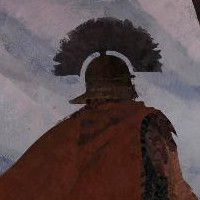
What was it that caused a hardened pagan executioner to defy a direct order from his procurator and pierce the Heart of Jesus and ultimately die as a Christian martyr in Cappadocia? As the overseer of the execution site, the centurion would not have heard striking words or witnessed miraculous wonders to cause him to convert; there was only silence and compliance from this suffering servant of God. Perhaps something caused this battle-tested commander to view the crucifixion of Christ through the chastened eyes of a soldier who recognized in it someone freely and selflessly sacrificing Himself so that others might live?
Longinus, who was not unfamiliar with death, may have seen that this was the most noble death for a soldier. The only greater death would be for the king himself, not one of his subject-soldiers, to willingly go out onto the battlefield, virtually alone and unarmed, surrounded by hordes of enemies who devilishly desired his death. Here, the King of Kings chose the hour and the location, which would not be on the high ground under the cover of night but in the light of day, in a very public, populated place, just outside the walls of the Great City.
He was not ashamed of his impending mocking, torture, and death, such that he wanted it to be accomplished in secret. Rather, He wanted all of Judah, and all exiled Israelites who were obligated to be in Jerusalem at this time of Passover, to be present at this first Good Friday, even though the huge crowd would bring with it far more mockery and humiliation of the King.
Christ alone faced the combined religious and political powers of Jerusalem and Rome, staring them down manfully and resolutely without equivocation, pleading His innocence, or crying out for mercy. He took on all the abandonment, insults, beating, and crucifying in unending wave upon wave without tapping out. Finally, after His final breath, he received the final blow: the head of an iron spear thrust through His side and into His Heart.
Whether the intent of this after-death wound was an altruistic act of admiration and mercy or a final offense and outrage against the Body of Christ is not for us to decide; it is known by God alone. What we do know is the Latin word “misericordia” means “mercy” or having a heart so full of compassion for another that it is rent open. Yet to this centurion of Rome, misericordia meant something seemingly quite different—or did it?
To the future St. Longinus, misericordia meant an act of battlefield honor and respect afforded only to the worthiest of warriors by driving an iron blade through the heart of a mortally wounded victim. In fact, some soldiers carried a dagger for such a purpose which was called a misericordia. In this regard, misericordia would have been, and eventually was, both an act of mercy by the centurion and a rending open of the Heart of the worthiest Victim so that His mercy could gush forth for the whole world. For the Heart of this Divine Victim was so full of compassion that it needed and desired to be immolated in order to pour out the last drops of His Blood and Water, which not only symbolized God’s love and mercy for the redemption and salvation of the world but were the supernatural reality which accomplished it.
Even though it appeared as if the desiccated Galilean succumbed to the sheer military might and masochism of the Roman Empire, in fact it was the Roman centurion who was overcome by the crucified Victim after He had breathed His last. Jesus triumphed not through words or miracles but through manfully taking within Himself all that the powers on earth could dish out and forgave them, even pouring out an ocean of mercy for their salvation.
Standing beneath the Cross, the centurion switched allegiances from the evil empire of the earth to the Kingdom of God, as evidenced by his defiance of a direct order from Pilate and obeying a prompting of the Holy Spirit to pierce Christ’s Heart rather than break His bones. Then, as the ranking Roman authority at Calvary, the centurion made a public proclamation that the dead Victim, not the live Caesar, was the true Son of God. Overcoming the centurion foreshadowed the future overcoming of the Roman Empire by the Kingdom of God and the fact that centurions would play a critical role in that eventual transfer of power.
Remember that in piercing the Heart of the Son of God, supernatural substances of Blood and Water gushed forth upon the head of the centurion, restoring his vision. But such same eternal elements which conceived the Church and became the source of her sacraments could have easily consecrated not just Longinus but an entire office or order of centurions to serve as the first soldiers of the Kingdom of God.
When the Kingdom came into its earthly existence at the Cross, it was embryonic and extremely vulnerable to the powers of the earth and its prince which were at eternal enmity with it. If, as Jesus said, a divided kingdom cannot long stand, a germinal kingdom devoid of defenders with powerful enemies likely never would see the light of day. This is why God, according to His perfect plan and providence, targeted the most indominable, indispensable men of the vaunted Roman military to tend, defend, and extend the Kingdom of God, fulfilling the Edenic duties which Adam abdicated.
This is not conjecture or wishful thinking; for the following five centurions in Scripture after St. Longinus did exactly that. The next centurion, Cornelius, was selected by God to clarify or correct the first pope by showing that Gentiles needn’t become Jews before becoming Christians, greatly aiding in the exponential expansion of this fledgling Faith. The next few centurions in Scripture saved the life of St. Paul, Christianity’s greatest evangelizer, on three separate occasions. And the first centurion mentioned in the Bible amazed Jesus who declared that he had the greatest faith in all of Israel.
Why else would all seven centurions in Scripture have been positively portrayed when they were oppressive overlords and occupiers of the land promised to Israel and were responsible for the persecution of countless Christians, including the martyrdoms of Sts. Peter and Paul? And why would God seemingly sideline His greatest asset of evangelization by allowing him to remain in Roman custody, in the constant company of centurions and soldiers, for the final four-plus years of his life?
The most plausible reason is that God wanted St. Paul to spend his remaining time and energy assembling soldiers for the Kingdom of God, so that they might tamp down the persecutions and spread the Gospel in Rome “throughout the whole Praetorian Guard” (Philippians 1:13) and to “all the rest,” even gaining converts in “Caesar’s household” (Philippians 4:22) and across the vast Roman Empire, wherever its legions and garrisons traveled or were stationed, reaching places where no apostle or ordained successor had gone.
In our time, does God want courageous, countercultural men of faith and action to reclaim the mantle of such a centurion office to tend, defend, and extend the Kingdom of God, which is led, in large part, by too many weak and worldly men, is virtually devoid of defenders, and has lost much land and many souls to the evil Spirit of the Age? To find out, please consider reading my book Rise of the Centurion: The Reclamation of a Mystical Masculine Theology (Sophia Institute Press).















.png)






.jpg)



 English (US) ·
  French (CA) ·