

 4 months ago
42
4 months ago
42

German Finance Minister Lars Klingbeil recently declared that
“Now is the time for a two-speed Europe. Germany, together with France and other partners, will therefore now take the lead in making Europe stronger and more independent. As the six biggest economies in Europe, we can now be the driving force.”
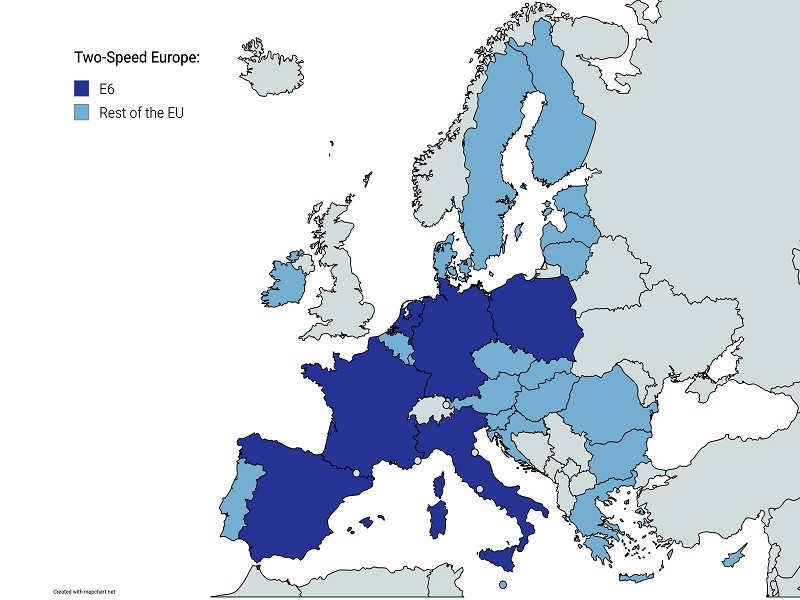
Apart from those two, this exclusive tier will also include Italy, Spain, the Netherlands, and Poland. The goal is to optimize decision-making by going around the EU’s consensus requirement.
Deutsch, Русский, 中文, عربي, Hebrew, Español, Portugues, Français, Farsi, Italiano, 日本語, 한국어, Türkçe, Српски. And 40 more languages.
According to the Washington Post, Klingbeil also sent a letter to his counterparts from the aforesaid countries announcing his intent for them to prioritize “a savings and investment union to improve financing conditions for businesses; strengthening the euro’s role as an international currency; better cooperation on defense spending; and securing resilient supply chains for critical raw materials.” His “two-speed Europe” proposal essentially functions as the EU’s adaptation to Great Power geopolitics.
.
.
Trump returned this approach to the fore of International Relations after authorizing the capture Venezuelan President Nicolas Maduro and the seizure of a Russian-flagged tanker in the Atlantic. The resumption of Great Powers prioritizing their national interests without being concerned anymore about accusations of violating international law bodes ill for the EU’s interests. After all, the US now wants EU member Denmark’s territory of Greenland, and the EU can’t stop the US even if it really wanted to.
This newfound self-consciousness of EU powerlessness has been brewing for a while, especially since the bloc was coerced by Trump’s tariff threats into agreeing to a lopsided trade deal with the US last summer, apparently inspired its de facto German leader to finally take action to rectify it to a degree. To be sure, the EU will probably never be able to restore its “strategic autonomy” vis-à-vis the US, but it could still possibly function more cohesively for making itself more competitive on the world stage.
For that to happen, member states will have to surrender more of their sovereignty to Brussels, thus furthering Germany’s long-running goal of federalizing the EU under its de facto leadership. This goal is being pursued through multiple means, including the EU’s planned transformation into a military union and creating a bigger pool of common debt through more funding for Ukraine. The challenge is that the EU’s consensus requirement for such major decisions allows smaller states like Hungary to stop this.
Therein lies the importance of Germany assembling an exclusive tier of EU members for making such decisions amongst themselves and then coercing their smaller peers into following suit through the momentum unleashed by them creating tangible facts on the ground. The clock is ticking since Poland’s ruling liberal-globalist coalition might be replaced by a conservative-populist one after fall 2027’s next parliamentary elections, however, ergo why Germany wants to get as much done as soon as possible.
These plans could be foiled even before then if Poland’s conservative president vetoes legislation associated with it since the ruling liberal-globalist coalition lacks the two-thirds majority to overrule him. Any moves by this exclusive tier that don’t require legislative approval to advance the EU’s de facto federalization could also be challenged by Poland’s Constitutional Tribunal and Supreme Court, which are at the center of a highly partisan dispute, thus possibly delaying implementation till the next elections.
Poland’s role in this German-proposed process is pivotal. Participation and tangible progress could create facts on the ground that are difficult to reverse even if the government changes after fall 2027. Likewise, resistance through the means described above could impede the aforesaid progress and possibly avert the associated consequences. If a conservative-populist coalition comes to power in Poland, it might then assemble regional allies to collectively and thus more effectively oppose these plans.
In that scenario, the EU could bifurcate into German- and Polish-led tiers, the first representing its legacy members and the second its new ones. Just like the German-led tier plans to make decisions amongst themselves and then coerce their smaller peers into following suit, so too could the Polish-led one do the same vis-à-vis their larger peers. These dynamics could result in the EU’s de facto dissolution into two distinct blocs that only remain united through their inherited policies like freedom of movement.
It’s therefore ironic that Germany considers its “two-speed Europe” proposal to be an adaptation to Great Power geopolitics that’ll enable the EU to function more cohesively for making itself more competitive on the world stage when this proposal actually risks dealing a deathblow to the EU as it now exists. The odds are still in Germany’s favor, but they could decisively shift after fall 2027’s next parliamentary elections in Poland, which are shaping up to be consequential for the entire continent.
*
Click the share button below to email/forward this article. Follow us on Instagram and X and subscribe to our Telegram Channel. Feel free to repost Global Research articles with proper attribution.
This article was originally published on the author’s Substack.
Andrew Korybko is an American Moscow-based political analyst specializing in the relationship between the US strategy in Afro-Eurasia, China’s One Belt One Road global vision of New Silk Road connectivity, and Hybrid Warfare. He is a regular contributor to Global Research.
Featured image by Freepik
Global Research is a reader-funded media. We do not accept any funding from corporations or governments. Help us stay afloat. Click the image below to make a one-time or recurring donation.











.png)





.jpg)


 English (US) ·
  French (CA) ·