

.png) 1 day ago
2
1 day ago
2
PROTECT YOUR DNA WITH QUANTUM TECHNOLOGY
Orgo-Life the new way to the future Advertising by AdpathwayPresident Donald Trump made a bold comment while speaking to Michigan automakers yesterday — but it wasn’t just the words he said. His tonal shift marks a longstanding tactic the president uses while giving speeches.
While at a General Motors facility outside of Detroit, Trump told the crowd he has done more to improve their lives than their own parents have.
“I’ve done more for you than your parents, OK?” Trump said. “Your parents are good. I’m not going to knock your parents, but I have been better to you than your parents — that I can tell you, and they would agree with me.”
Trump: "I've done more for you than your parents, okay? Your parents are okay. I'm not gonna knock to your parents, but I have been better to you than your parents." pic.twitter.com/cGlPdc21yW
— Aaron Rupar (@atrupar) July 27, 2026HuffPost sent the clip to experts who confirmed that the president’s tone seems to change a bit while telling Michigan automakers that he’s better than their parents.
“He sounds pretty gravelly in general in that speech (you notice it at the beginning), but he’s also doing that whole section as a bit,” Nicole Holliday, an associate professor of linguistics at the University of California, Berkeley, told HuffPost.
Holliday argued that by slightly tweaking his voice compared to the rest of the speech, which he is reading off a teleprompter, Trump was emphasizing that he’s making a joke on a whim.
There is a sociological concept coined by Erving Goffman at play here, Holliday pointed out. The president uses his “front stage” voice when reading from a teleprompter — it’s a more deliberate and performative voice — because he is aware people are watching and need to hear what he has to say.
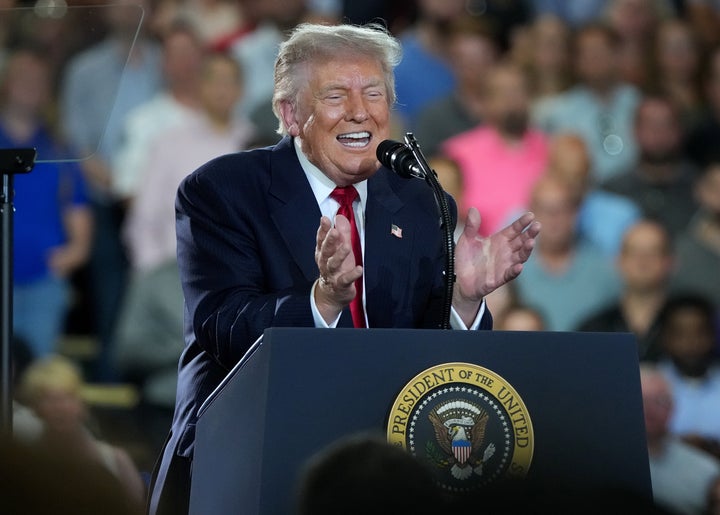
Andrew Harnik via Getty Images
But when Trump intentionally goes off-script to make a joke or say something he really feels that isn’t written in the speech, his tone changes to his “backstage” voice. This is more unguarded and supposed to feel more relaxed and personal to listeners.
“We see this pretty often when he says something off the cuff and then has to double down on it,” Holliday continued. “Basically, it’s an aside, and the quality of his voice — rougher and louder — sets that section apart from the rest of the speech and helps the listener interpret it in a sort of ‘backstage’ voice.”
“It works with his supporters because it offers them a little sneak peek into the backend of what he really thinks, not what someone wrote for him,” Holliday said.
That perceived spontaneity is central to how Trump’s supporters read him — and is how he tends to get away with what he says, Karrin Anderson, a professor of communications at Colorado State University, told HuffPost.
“When a president delivers a prepared speech, people tend to think it’s less authentic than something delivered off-the-cuff,” Anderson said. “Trump interjects unscripted moments into his speeches as a way of bolstering perceptions of authenticity.”
“[This] is not a sign that Trump is actually more authentic than other politicians,” Anderson said. “But the fact that Trump goes off-script makes some people feel like he’s not a typical politician.”
That performance is what played out at the GM event. And by using this more performative backstage voice when saying he’s done more for autoworkers than their parents have, Trump can also leverage it to be “clearly a joke.”
“It gives him plausible deniability,” Holliday said. “When he says these things that are the most absurd or the most offensive, that’s when you’ll see his voice change, and so he can always go back — and he does this often — and say, ‘Obviously, I’m joking. You just didn’t get it.’”






.png)





.jpg)



 English (US) ·
  French (CA) ·