

.png) 4 months ago
44
4 months ago
44
PROTECT YOUR DNA WITH QUANTUM TECHNOLOGY
Orgo-Life the new way to the future Advertising by AdpathwayImmediately after Bad Bunny’s Super Bowl halftime show, President Donald Trump lashed out on Truth Social, calling the Puerto Rican superstar’s performance “disgusting,” a “slap in the face,” and “an affront to the greatness of America.”
But one of Trump’s biggest complaints is also one that is blatantly not true.
“Nobody understands a word this guy is saying,” Trump wrote.
The 41 million Spanish-speaking Americans in the U.S. and 500 million Spanish speakers worldwide would beg to differ.
Trump’s statement is not just inaccurate, according to census data, it is actively erasing whole communities, said Damián Wilson, a professor of Spanish at the University of New Mexico.
“If the President is saying ‘nobody,’ it’s excluding all the Spanish speakers in our country, and erasing them,” he said.
“This is a country where we speak English, not Spanish,” Trump said in 2015, dismissing the 350 languages spoken throughout the nation.
The power of Trump’s English-only view has extended beyond opinion into national policy. Last year, Trump signed an executive order designating English as the official language of the United States. Under Trump’s deportation agenda, federal immigration agents are profiling people with Spanish accents and asking them to provide proof of citizenship.
So when Trump states that “nobody” understands Bad Bunny, he is “doubling down on the ideology and rhetoric that we already know is coming out of this administration and its allies, and that is rhetoric that demonizes Latinos and immigrants, presents them as foreign threats to the United States,” said Petra Rivera-Rideau, a Wellesley College American Studies associate professor and co-author of the book “P FKN R: How Bad Bunny Became the Global Voice of Puerto Rican Resistance.”
“The backlash against Spanish at the Super Bowl is about so much more than Bad Bunny, and it predates Donald Trump,” Rivera-Rideau said. There is “a very long history in the United States of using Spanish as a symbol of a potential foreign takeover.”
“America is not the United States. The United States is part of America.”
- Ileana Pérez, Ph.D. candidate in Hispanic linguistics at Ohio State University
This is not the first time a Spanish-language performer for a major U.S. sporting event has been deemed unpatriotic for being who they are. In 1968, Puerto Rican artist José Feliciano won a Grammy and then performed the national anthem in English, with Latin-tinged guitar, at the World Series. The criticism he faced afterward was similar to what we’re hearing now: “‘He is a foreigner,’ ‘He doesn’t belong,’” Rivera-Rideau said.
Last year, amid anti-deportation protests in the city, Latina R&B musician Nezza said the Los Angeles Dodgers told her not to sing the Spanish version of the “Star-Spangled Banner” for the team’s game, but she did it anyway.
That’s why Bad Bunny dancing to salsa and reggaeton with his distinctly Puerto Rican Spanish lyrics is not just joyful –– it’s a political act of resistance against Trump and too many other people’s narrow-minded idea of how Americans in the U.S. should sound.
“That whole halftime show spoke to everyone, and then also had messages that were just for Spanish-speaking Latinos, too, or for people who are in the know,” Rivera-Rideau said.
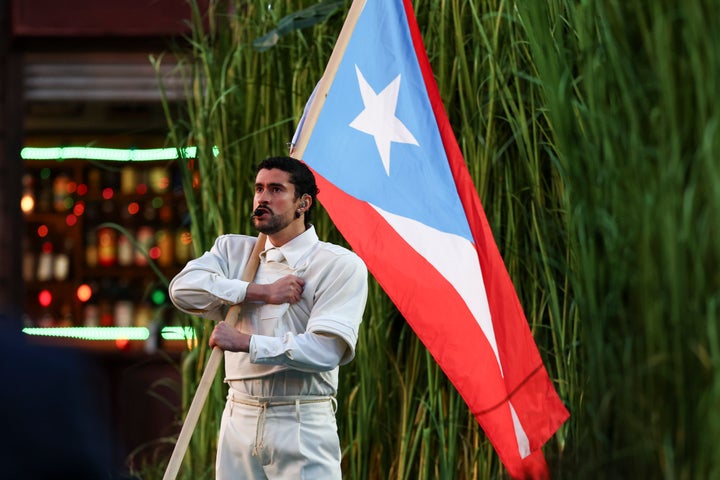
Kevin Sabitus via Getty Images
“The rhetoric of ‘Nobody can understand him,’ to me, feels also like an accusation that he is excluding groups of people, people who are imagined to be real Americans,” Rivera-Rideau said.
Proponents of English-only policies say one common language is necessary because speaking different languages is exclusionary, but Bad Bunny’s performance purposefully creates bridges between different worlds.
Take halftime show guest star Lady Gaga singing in English with a salsa band behind her. “That’s not exclusionary. That’s an invitation into [Bad Bunny’s] world,” Rivera-Rideau said.
Bad Bunny excelled in balancing that universal message of unity and honoring his Spanish-speaking fans who don’t need translations. In the show, he looks at the camera and directly says in Spanish that he got here because he believed in himself, and he wants you all to believe in yourselves, too, because you’re worth more than you think.
By “saying that in Spanish, he’s speaking to a group of people that is being subject to these racist and xenophobic attacks,” Rivera-Rideau said. “I think that’s really important.”
Bad Bunny Ends Show With Pointed Statement For All Americans
In his Truth Social post, Trump said Bad Bunny lacks creativity, excellence or success: “There is nothing inspirational about this mess of a Halftime Show...MAKE AMERICA GREAT AGAIN!”
Invoking MAGA to call out Bad Bunny is also wrong. “America is not the United States. The United States is part of America,” said Ileana Pérez, a Ph.D. candidate in Hispanic linguistics at Ohio State University.
Bad Bunny makes this point by saying “God bless America” in English and then listing most of the countries in the Americas, including Chile, El Salvador, the United States and Canada.
“He reminded us that it’s a continent, and it’s composed of a lot of countries. [The] United States is just one portion of it. It’s not the whole thing,” Pérez said. “And so to keep saying ‘Make America Great Again’ is ridiculous because it’s composed of all these different regions, and it’s already great.”
Despite Trump’s ongoing efforts to limit the reach of Spanish, researchers estimate that the U.S. will become the second-largest Spanish-speaking nation in the world, after Mexico, in 2060. Bad Bunny knows the future of the U.S. includes Spanish speakers and Latines, and his final moments of the show highlight this.
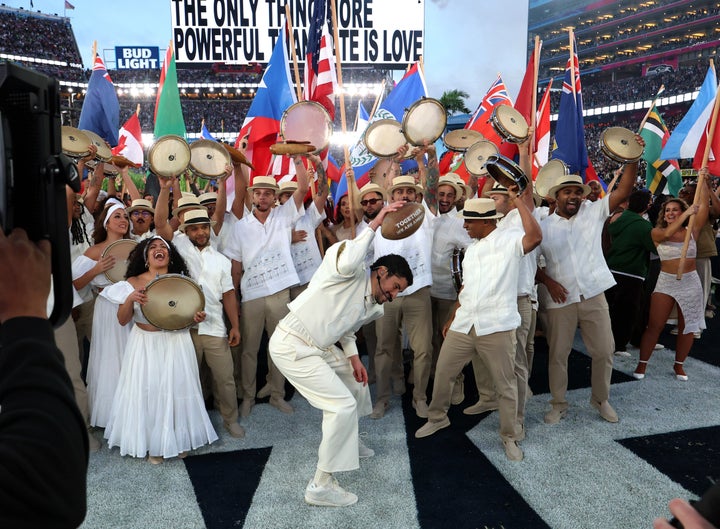
Kevin Mazur via Getty Images
After listing out countries of the Americas, Bad Bunny ended the show by saying “Seguimos aquí,” which means “We’re still here,” in Spanish. He then spikes a football inscribed with the message, “Together We Are America” in English.
To Rivera-Rideau, this is “a very profound, moving statement” because “Seguimos aquí” references a short film made for Bad Bunny’s “Debí Tirar Más Fotos” album. In the film, an older man (Puerto Rican filmmaker Jacobo Morales) struggles to place his usual order at a local Puerto Rican bakery that has completely gentrified, doesn’t accept cash, and has an employee who doesn’t speak Spanish. A different Puerto Rican man steps in and pays for him, telling the older man, “Seguimos aquí.”
In that context, “Seguimos aquí” means “We are persevering. We are still here. We are still on our land in the face of this profound wave of gentrification and displacement,” Rivera-Rideau said.
But by saying this phrase on the world stage, Bad Bunny is also addressing the resilience of Spanish speakers in the United States, Latines and all immigrants under threat.
“You can try to say that the very essence of being a Spanish-speaking Puerto Rican person is antithetical to American values, but we’re here,” Rivera-Rideau said. “We’re valuable. We contribute to this country, and we’re an essential part of the fabric of the United States. And we’re not going anywhere.”





.png)




.jpg)

 English (US) ·
  French (CA) ·