

 4 days ago
4
4 days ago
4

The Western left’s choice of “empire” over “imperialism” is no stylistic preference; it is an ideological retreat from political economy and Leninist analysis toward an imperialist-compatible critique
*
A Confession
In the mid-1990s, I translated Michael Parenti’s Against Empire into Turkish. I was not entirely comfortable doing it. The discomfort was not with Parenti’s politics — his anti-imperialism was genuine, his courage in naming American power was real. The discomfort was with the title itself, and with the vocabulary that ran throughout the book. Parenti said “empire.” He said “imperial.” He almost never said “imperialist” in the full Leninist sense of the word. And yet everything he described —the export of capital, the subordination of peripheral economies, the military enforcement of financial interests— was, in substance, precisely what Lenin had analyzed in 1916 under the title Imperialism, the Highest Stage of Capitalism.
I told myself at the time that I had no right to change the author’s chosen vocabulary. That was a reasonable scruple for a translator. But it masked a deeper uncertainty: I could not explain, even to myself, why a writer of Parenti’s political commitments was using “empire” instead of “imperialism.” I assumed there must be a reason I did not yet understand. I translated “empire” as imparatorluk and moved on.
Why did I not write to Parenti and ask him directly? I have asked myself this question many times since. The honest answer is probably several things at once: a translator’s deference to the author’s choices, an inability to fully articulate what was bothering me, and —perhaps most tellingly— a suspicion that the answer would not satisfy me. That suspicion was itself a kind of knowledge I did not yet know how to use.
Thirty years later, I can say plainly: there was no good reason. The choice of “empire” over “imperialism” in the English-speaking left is not a theoretical refinement. It is an ideological retreat —sometimes unconscious, sometimes not— from the analytical framework that makes the critique of capitalism’s highest stage possible in the first place.
Two Words, Two Worlds
The distinction is not pedantic. “Empire” and “imperialism” do not describe the same thing.
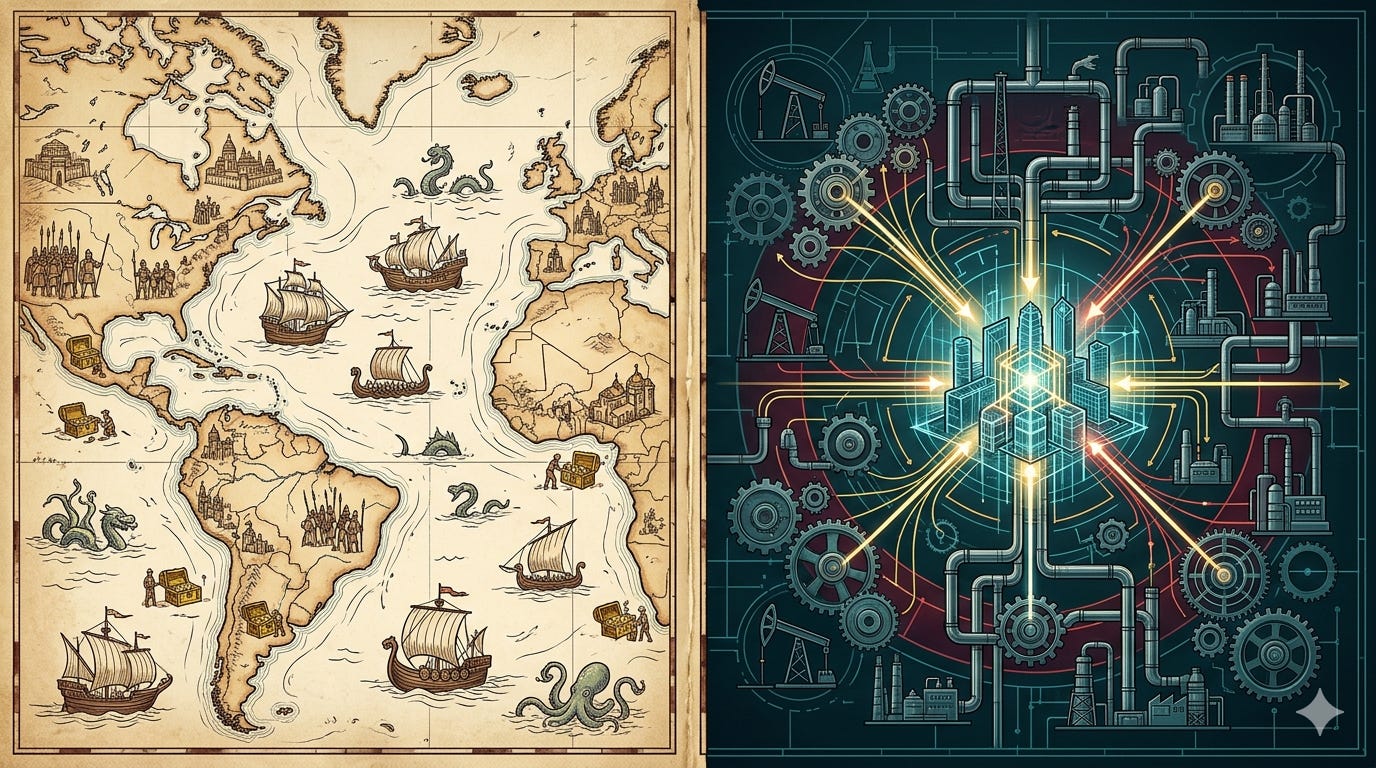
“Empire” as a historical-political category belongs to feudal and pre-feudal socio-economic formations. Its internal logic is not that of capital accumulation but of tribute, not of surplus value extraction but of direct coercive appropriation —slave labour, serf bondage, tributary obligation— not of capitalist class relations but of hereditary hierarchy and personal bondage. Rome, the Ottomans, the Mongols, the Chinese dynasties — these were not nation-states. They were multi-ethnic, centrally hierarchical structures without modern borders, without sovereignty in the contemporary sense, without citizenship. A center and its dependent rings, bound by personal loyalty, dynastic claim, and tributary relation. The word “empire” carries this genealogy whether its users intend it or not. It does not explain. It displays. And what it displays belongs to a world that predates capitalism, predates the nation-state, predates the very formations within which imperialism operates.
A concept that can mean everything means nothing. In contemporary left discourse, “empire” has become precisely such a concept — capacious enough to accommodate US unilateralism, Western financial architecture, Anglo-American cultural hegemony, and NATO military reach all at once, without explaining the structural relationship between any of them. One recent piece in the left press referred, within a few paragraphs, to “the US empire,” “the US-led empire,” “the US-led bloc,” and “the imperial core” — apparently interchangeably. Each of these formulations gestures toward something real. None of them explains the mechanism that connects them. “Imperialism,” by contrast, is not capacious. It is precise. And that precision is exactly what has made it unwelcome.
“Imperialism,” in the Leninist sense, is something categorically different from empire. It does not describe a form of domination that precedes the nation-state — it describes a stage of development within the nation-state system. It is an analytical concept designating a specific historical stage of capitalist development: the dominance of finance capital over industrial capital, the merger of banking and industrial monopolies, the export of capital as the primary mode of surplus extraction, the territorial and political division of the world among the great capitalist powers. Lenin was explicit: imperialism is not a policy that states choose or reject. It is the necessary product of capitalism’s internal logic at a certain stage of its development. It is structural, not incidental.
To speak of imperialism is, at its core, to insist that the international order is not a relation between states of unequal size, but a reflection of class struggle on the international arena. The exploitation of the periphery and the exploitation of the metropolitan working class are not parallel phenomena — they are expressions of the same system. “Empire” cannot say this. It has no vocabulary for it.
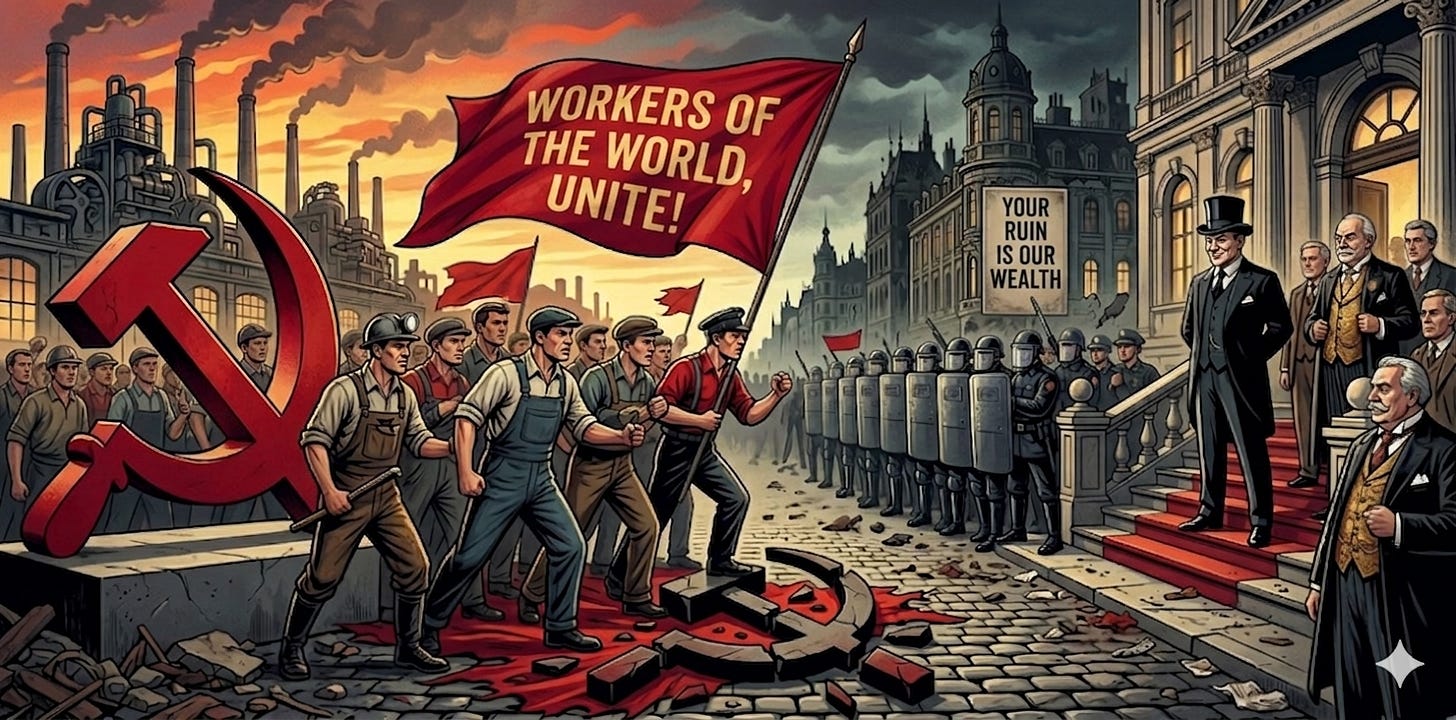
Lenin did not title his pamphlet “The Highest Stage of Empire”. He knew what he was doing. “Imperialism” named the mechanism. “Empire” would have named only the scenery.
When the contemporary left —including its Marxist tendencies— systematically replaces “imperialism” with “empire,” it is not making a neutral stylistic choice. It is abandoning the mechanism and keeping the scenery.
.
.
The “So What” Answer
Over the years, as my discomfort grew, I raised this question with Marxists whose first language was English. The responses were, with rare exceptions, disappointing. Some said the two terms were interchangeable — “just different words for the same thing.” One colleague, exasperated, told me: “So what? They’re both just bullshit labels.” Nobody offered a theoretically coherent defense of the substitution.
The “so what” response is not a neutral shrug. It is itself an ideological position — one that dismisses conceptual precision as bourgeois pedantry while, in practice, doing precisely what the bourgeoisie requires: erasing the Leninist framework from the vocabulary of critique. If “imperialism” and “empire” are just the same bullshit, then Lenin’s analysis is also just bullshit — one label among others, interchangeable, disposable.
This is not a coincidence. The systematic degradation of Leninist vocabulary in the Anglo-American left did not happen spontaneously. It has a history — in the institutional capture of Western Marxism by Cold War-era academic funding, in the Frankfurt School’s aestheticization of critique, in the long displacement of political economy by cultural theory. The result is a left that can describe power but not explain it; that can name suffering but not trace its structural origins; that says “empire” because “imperialism” would require saying Lenin, and Lenin would require saying finance capital, and finance capital would require saying something that makes tenure committees uncomfortable.
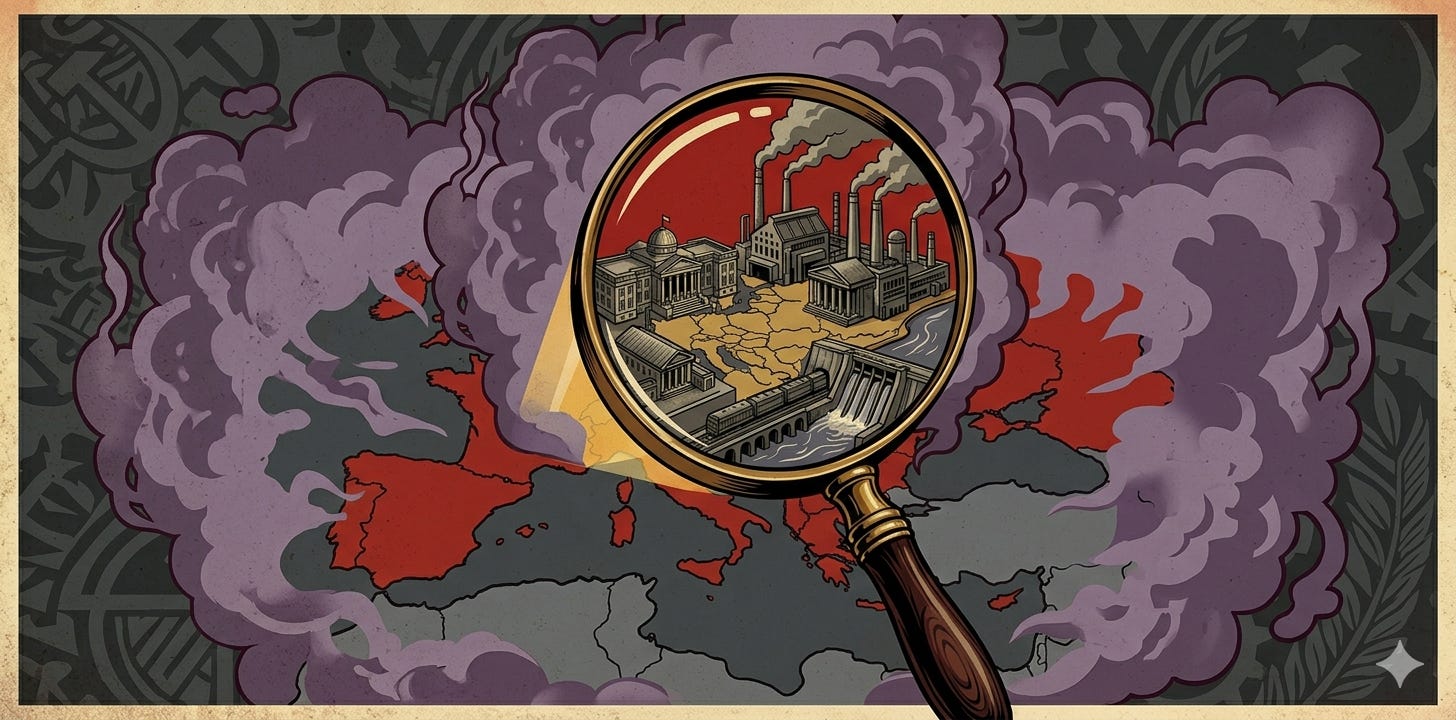
What has been produced, in other words, is what might be called an imperialist-compatible left: a tradition whose defining features — hostility to actually existing socialism, evacuation of political economy in favour of culture and discourse, moralism in place of organisation, allergy to state power and revolution — rendered it not merely tolerable but useful to the imperial order. The preference for “empire” over “imperialism” is not incidental to this tradition. It is one of its symptoms.
.
.
Parenti’s Limits
I want to be fair to Parenti. He was a polemicist of real courage. He named American power in terms that his academic contemporaries would not. His politics were consistent. But his theoretical formation was thin.
One example, minor in itself but symptomatic: when Parenti used the terms “First World,” “Second World,” and “Third World,” he treated them as meaning simply rich countries, other developed countries, and poor countries — a roughly geographic-economic classification that places both superpowers in the First World without further differentiation. There is no evidence in his writing that he was aware of Mao’s Three Worlds Theory, which, whatever its own theoretical problems and contested political consequences, was at least constructed within a framework of class analysis on the international arena and geopolitical contradiction. The distinction matters. The NGO-style reading of “Third World as poor countries” is a liberal humanitarian category. Mao’s framework was an attempt at structural analysis — one with serious and rightly debated political implications, including the designation of the USSR as social-imperialist, a rapprochement with the United States, and support for certain reactionary forces in national liberation struggles. These are real problems, internal to a structural analysis. Parenti’s classification has no structure to be internally problematic. It is simply a moral geography.
When I translated Against Empire, I felt compelled to add a footnote explaining this gap in extremely tactful terms. A translator should not normally need to supply the theoretical context that the author himself is missing. It was a small sign of something larger: Parenti used Marxist vocabulary as moral ammunition rather than as analytical instrument. His Marxism was a compass, not a method.
This is not an isolated personal failing. It is the characteristic form of Anglo-American left politics: strong moral conviction, weak theoretical architecture. The choice of “empire” over “imperialism” is entirely consistent with this pattern. You do not need Lenin to have a moral objection to American power. You only need Lenin —you only need “imperialism”— if you want to explain it.
.
.
The Hidden Pride
There is, I want to suggest, a psychological dimension to this vocabulary that is rarely acknowledged. The word “empire” does not only soften the critique. It also elevates the critic.
To speak of “the American Empire” —in the softened, de-Leninized sense— is to position oneself as a dissident citizen of a world-historical colossus. There is a grandeur to this position, even in its critical form. “We are the empire” carries, beneath its apparent self-condemnation, a note of sublimated pride. Rome was an empire. Britain was an empire. And now we. The scale of the guilt is itself a measure of the scale of the power — and therefore of the speaker’s proximity to that power.
I encountered a vivid illustration of this mechanism in a Norwegian newspaper. A columnist was performing an act of collective self-criticism on behalf of Norway, arguing that Norway too bore responsibility for the history of the slave trade: after all, Norway had been part of Denmark at the relevant period. The tone was appropriately solemn — the language of reckoning, of moral courage, of refusing to look away.
But Norway only became an independent state in 1905. Before that it was under Danish, and then Swedish, domination. Norway was not a colonial power. It was, in significant respects, itself a subordinate nation. The columnist’s insistence on sharing in the guilt of the colonial empires was not, in any serious historical sense, an act of accountability. It was an act of identification — a desire to belong to the grand narrative of world-historical agency, even at the price of world-historical guilt. To be implicated in empire is still to be part of empire. And that is, at some level, a coveted position.
The same logic operates in left discourse about American power. “Imperialism” in Lenin’s sense is a structural category — it describes a system, not a civilization, and it positions its analyst outside and against that system. “Empire,” by contrast, is a civilizational and feudal category — pre-capitalist, pre-nation-state — and it invites identification, even oppositional identification, with the grandeur of the thing being criticized. The critic of empire is still, in some sense, a citizen of empire, and that citizenship confers a certain status.
“Imperialist” strips that away. It is not a noble word. It has no aesthetic dignity. It names a predatory mechanism of capital accumulation operating through and within the nation-state system. To use it seriously is to step outside the civilizational frame entirely — and that is a step many on the left are not prepared to take.
Conformity Without Surrender
It would be unfair to characterize all of this as conscious capitulation. Some of it is. Academic Marxists who know their Lenin and still write “empire” have made a choice — they have weighed the costs of theoretical fidelity against the rewards of institutional legibility and chosen accordingly. That is surrender, and it should be named as such.
But much of it is something more insidious: a conformity so thoroughly internalized that it no longer feels like conformity. The dominant academic and media culture of the English-speaking world has made “imperialism” —in Lenin’s sense— sound shrill, dated, ideologically crude. “Empire” sounds sophisticated, nuanced, theoretically informed. The Hardt and Negri volume of that name, published in 2000, performed this operation with considerable elegance: it took the word “empire,” stripped it of its Leninist content, and returned it to left discourse as a postmodern network concept with no fixed center, no finance capital, no class interest — just flows and multitudes and deterritorialized power. Lenin was not refuted. He was simply made to seem unnecessary.
The gravitational pull of this substitution can be measured by the writers it has captured. Gabriel Rockhill is one of the most rigorous critics of Cold War anti-communist Marxism, a scholar who has done serious archival and theoretical work on CIA cultural operations, and who has embraced the Losurdian recovery of the communist tradition against its imperialist-compatible distortions. His work has made powerful enemies precisely because he applies historical materialism consistently — including to the Western Marxist tradition itself, and to those who have built careers within it. It is exactly this consistency that has drawn responses not of theoretical engagement but of institutional intimidation and open class contempt: the classic repertoire of gatekeepers who know that the terrain they occupy cannot withstand open materialist examination. And yet — even in Rockhill’s writing, “empire” appears where “imperialism” belongs. This is not a political failing. It is testimony to how deeply the substitution has been normalized. If it has reached writers of this calibre and commitment, the problem is structural, not individual.
The result is a left that is permanently eloquent and permanently powerless. It has sophisticated descriptions of power and no theory of how power actually works. It has moral passion and no political economy. It says “empire” because “imperialism” would force it to answer questions it has spent decades learning not to ask.
.
.
Britain, the United States, and the Word They Inherited
A distinction must be drawn between two very different cases of “empire” usage, even within the English-speaking world.
Britain is an imperialist state that carries the institutional memory, the bureaucratic structures, and the nomenclature of its colonial empire into the present. The word “empire” in British usage is at least the echo of something historically real — the unbroken continuity between the colonial apparatus and the contemporary state. This does not make the usage theoretically correct. “Empire” remains a pre-capitalist, feudal-formation term; it describes a mode of domination that predates the specific mechanisms Lenin analyzed. Britain underwent bourgeois revolution —Cromwell’s Commonwealth, the Glorious Revolution— but never the clean institutional rupture of the French model. The old aristocracy and the new bourgeoisie fused rather than the former being swept away. Feudal titulature, the monarchy, the Lords, the established church — all survived, repackaged within a capitalist order. The word “empire” clung to British self-description for this reason: the inherited language of a ruling class that never fully shed its pre-capitalist costume. That it persists in British left discourse reflects the same conservatism — the inability to break with inherited categories even when they obscure rather than illuminate.
For the United States, no such historical excuse exists. The USA has no feudal titulature to preserve, no colonial bureaucracy whose nomenclature it inherited, no unbroken institutional continuity with an actual territorial empire in the feudal sense. It was founded as a capitalist republic from the outset — a state that emerged without feudal antecedents, without tributary relations, without dynastic territorial claims. To apply the category “empire” to the United States is not merely anachronistic. It is a categorical error: the imposition of a pre-capitalist, feudal-formation concept onto the most developed capitalist state in history. “Empire” for the United States is not a historical residue. It is an aspiration dressed as description.
To call the United States an empire is, in this sense, to do American exceptionalism a favor: it places the USA in the grand lineage of Rome and Britain, civilizational colossi, rather than naming it for what it actually is — the dominant imperialist power of the current stage of global capitalism.
.
.
“Soviet Empire” and the Weaponization of the Word
A separate but related operation must be noted. The same word — “empire” — was deployed throughout the Cold War in an entirely different register and with an entirely different purpose: “Soviet empire.” Here the use of “empire” was not theoretical retreat but deliberate anti-communist weaponry.
To describe the Soviet Union as an empire was to perform two maneuvers simultaneously: to present it as mere continuity with Tsarist despotism —no revolution, no rupture, just new management— and to construct a moral equivalence between American imperialism and Soviet “imperialism,” two superpowers, two empires, equally guilty. This was the classic Cold War false equivalence. The same word, then, served opposite ideological functions depending on who wielded it and against whom: in left discourse about American power, “empire” softened and aestheticized the critique; in anti-communist discourse about the Soviet Union, it sharpened and weaponized the accusation. What unites both usages is the systematic evasion of Lenin’s analytical category — in one case by abandoning it, in the other by inverting it.
Mao Zedong’s concept of the “two superpowers” offers an instructive contrast. The Chinese term is 超级大国 — chāojí dàguó. The character 国 (guó) means “state”, “country”, “nation” — not “power” in the abstract sense. 大 (dà) “big”, “great”, “large”. 大国 alone means “great state” or “large state” — a state of extreme, excessive, overwhelming scale and dominance since the prefix 超级 (chāojí) marks this as categorically beyond ordinary greatness. Crucially, 国 anchors the concept in the concrete reality of state formation: sovereignty, territory, institutional structure. The standard Western translation “superpower” loses precisely this anchor — replacing the concrete notion of state with the vague, deterritorialized notion of “power.” The mistranslation is not innocent. It participates in the same erasure of structural concreteness that the substitution of “empire” for “imperialism” performs.
More importantly, Mao’s framework did not seek to delegitimize the Soviet revolution or excuse American hegemony. It sought to carve out an independent political position for the colonized and semi-colonized world — to subject both dominant states to structural critique from below, not to flatten the difference between them for Cold War propaganda purposes. Whatever the controversies of Mao’s Three Worlds Theory —and they are real— its analytical intent was the opposite of the “Soviet empire” jargon: one aimed at independent political agency for the oppressed nations of the world, the other at ideological pacification in the service of Western hegemony.
.
.
The Word That Matters
Words are not merely labels. They carry analytical commitments. To say “imperialism” in Lenin’s sense is to commit to a set of claims: that capitalism has a highest stage, that finance capital is its dominant form, that the division and redivision of the world among monopoly capitalist powers is not a policy option but a structural necessity, that this system operates through and within the nation-state order rather than replacing it, and that the critique of this system requires understanding it as a system — not merely deploring its excesses.
To say “empire” instead is to make none of these commitments. It is to retain the emotional charge of critique —the indignation, the moral positioning— while releasing the theoretical obligations that would give that critique teeth. It is, above all, to dissolve the connection between international domination and class struggle — to make the world safe for a left that is outraged by power but unwilling to explain it.
I am not suggesting that every writer who uses “empire” is a conscious agent of ideological pacification. Most are not. The conformity is largely unreflective, which makes it more, not less, effective. What I am suggesting is that the consistent, decades-long displacement of “imperialism” by “empire” in left discourse is not a neutral development. It is a symptom of theoretical regression — of a left that has become more comfortable with moral witness than with structural analysis, more at home in the language of the academy than in the language of political economy.
Lenin wrote Imperialism, the Highest Stage of Capitalism in 1916, in conditions of exile and censorship, because he understood that without theoretical clarity there could be no political clarity — and without political clarity, no effective opposition to the forces that were then, as now, dividing the world among themselves.
The word he chose was “imperialism.” It was not an accident. Recovering that word —with everything it commits us to— is not a matter of theoretical nostalgia. It is a precondition of understanding what is happening in the world today, and of opposing it with something more than eloquence.
*
Click the share button below to email/forward this article. Follow us on Instagram and X and subscribe to our Telegram Channel. Feel free to repost Global Research articles with proper attribution.
All images in this article are from the author
Global Research is a reader-funded media. We do not accept any funding from corporations or governments. Help us stay afloat. Click the image below to make a one-time or recurring donation.












.png)




.jpg)



 English (US) ·
  French (CA) ·