

.png) 18 hours ago
4
18 hours ago
4
PROTECT YOUR DNA WITH QUANTUM TECHNOLOGY
Orgo-Life the new way to the future Advertising by AdpathwayPerplexed by the world of vegan and plant-based leather? I’ve rounded up 16 sustainable alternatives right now – including the fully plastic-free options – to help keep you right.
It’s a hard stretch to class conventional leather as eco-friendly. From animal welfare and cruelty issues to large-scale deforestation, increased methane levels, and toxic pollution from the industry, there’s a lot wrong with leather.
However, vegan leather isn’t a straightforward sustainable swap. The term “vegan leather” has actually become one of the most greenwashed claims in recent years. Here’s why, and some more sustainable alternatives:
What’s Wrong With Vegan Leather?
Many brands have been guilty of rebranding their faux leather (also known as pleather) as “vegan” and “eco-friendly” when they are, in fact, made of synthetic, fossil-fuel-based plastics.
Largely made of polyurethane (PU) or polyvinyl chloride (PVC), these aren’t sustainable materials.
PVC, in particular, is regarded as the most toxic of all plastics. As well as being a known human carcinogen, it’s known to cause diabetes, as well as damage immune systems, disrupt hormones, and create birth defects.
PU is slightly better. It requires fewer chemicals than PVC to produce. Although it is still toxic, particularly in the workplace, it is less toxic than PVC. Manufacturers are also now able to make PU with plant-based raw materials to make it safer, but not all do.
Guide to Vegan Leather Alternatives
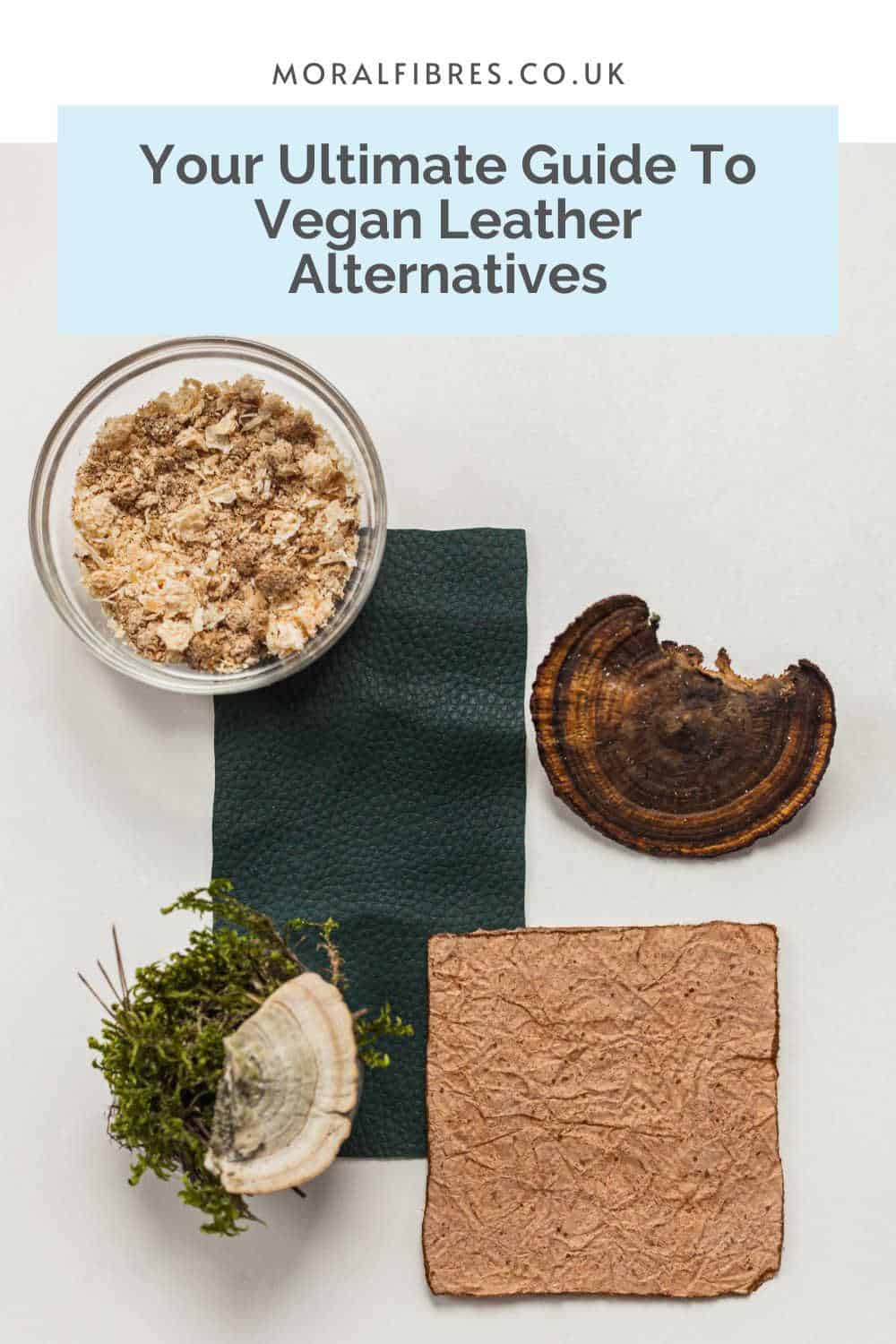
Times are changing, though. Many innovative manufacturers are now making vegan leather from a whole host of more sustainable materials.
To help you learn more about the world of plant-based leather alternatives, I’ve rounded up 16 different types of faux leather. Most are made with the addition of PU plastics – so aren’t plastic-free.
However, excitingly, a handful of companies here are managing to make their leather without the use of plastics. To help you out, I’ve highlighted where I believe the leathers are made with or without plastic.
Agave Leather
❌ not plastic-free
Made by a company called Adriano Di Marti, Desserto agave leather utilises waste from Mexico’s tequila industry to make this innovative fabric. Using the leaves and the bagasse (the sugar cane pulp) helps reduce waste from the drinks industry whilst offering a plant-based alternative to leather.
AppleSkin
❌ not plastic-free
AppleSkin leather, made by Vegatex, is made from apple by-products leftover from the beverage industry. This includes the seeds, stalks, and skins.
These items were traditionally discarded, but Vegatex takes this otherwise unusable apple waste, reduces it, and dries it out to form a fine powder. Once the waste has been crushed into powder form, it’s then combined with PU and then coated onto a cotton and polyester canvas. It works out at around a 50:50 apple-to-PU blend.
Banana Leather
❌ not plastic-free
Also known as Banofi, this vegan leather alternative is made from banana crop waste (such as the stems and leaves) sourced from smallholder farmers. This provides banana farmers with additional income for their crop waste, whilst creating products from waste that would otherwise be burned.
From this waste, the fibres are extracted, then combined with a blend of natural and synthetic additives. This is then coated onto a fabric backing to create banana leather.
Cactus Leather
❌ not plastic-free
Also known as Desserto, cactus leather is made by the same company as agave leather. This innovative vegan material is made from the leaves of the prickly pear cactus. This hardy plant requires very little water to grow, making it a more environmentally friendly option compared to other water-intensive crops.
Turning the leaves into leather involves harvesting the mature leaves, drying them under the sun, and then processing them into a durable material.
Coconut Leather
✅ tends to be plastic-free (but check individual products)
Also known as Malai, coconut leather isn’t quite what it sounds. Instead of being made from coconut flesh, it’s surprisingly made from fermented coconut water. The end result is a flexible, durable and water-resistant material that doesn’t need to be treated with plastic coatings.
Coffee Leather
❌ not plastic-free
Globally, we drink a LOT of coffee, so environmentally, it makes sense to do something with waste coffee grounds. To help tackle this coffee waste mountain, the clever people at Culthread have come up with the idea of making coffee leather.
Its coffee leather is made from 30% recycled coffee grounds and 70% recycled water bottles and then coated with PU for strength and durability.
Cork Leather

✅ tends to be plastic-free (but check individual products)
Cork is a super sustainable material as it’s naturally harvested by hand, without damaging the rest of the tree. The cork is then boiled in water, flattened and pressed into flat sheets to make a flexible leather-like material that can be used to make a variety of accessories, such as bags and shoes.
However, just because cork itself is sustainable, it doesn’t necessarily mean cork products are eco-friendly.
This is because a fabric backing is pressed onto the cork sheet to prevent the cork from breaking. Some factories use actual leather for the backing, so just because a product is made of cork, don’t automatically assume it is vegan-friendly.
Other factories use cotton, polyamide, PU, polyester, or a mix of cotton and PU. Most brands use polyester and/or PU as the backing fabric, as it’s quicker, easier and cheaper. If you’re looking for cork with the lowest environmental impact, look for cork products lined solely with cotton.
Corn Leather
❌ not plastic-free
Corn leather is a vegan leather alternative made from, you guessed it, corn. The corn is harvested and then fermented to extract a simple sugar called dextrose. The dextrose is then used to create a polymer – a bioplastic – that can be used to make heaps of different products – from plant-based teabags to faux leather clothing and accessories.
Grape Leather
❌ not plastic-free
Sometimes known as wine leather, grape leather is made by a company called Vegea. Utilising grape leftovers from the Italian winemaking industry – including the skin, stalk and seeds. These are processed into a pulp and then transformed into a leather-like material using bio-based plastics.
LemonSkin
❌ not plastic-free
Similar to AppleSkin, LemonSkin is made from lemon by-products from the beverage industry. The lemon is powdered and mixed with PU, before being coated onto a lyocell or recycled polyester backing.
Kombucha Leather
❌ not plastic-free
As you have seen so far, vegan leather can be made from a host of surprising materials. So it won’t shock you to learn that plant-based leathers can also be made from kombucha – the fermented tea drink.
Kombucha leather is made from what’s known as the SCOBY – short for the symbiotic culture of bacteria and yeast. A SCOBY is an ingredient added to aid the fermentation process of kombucha. The SCOBY grows thicker with each batch made, as it feeds on the sugars and nutrients of the tea.
Once it gets to the right size, it can be dried and moulded into shape to form kombucha leather. It’s not a leather that’s currently used much, but who knows what could happen in the future.
Mango Leather
❌ not plastic-free
Fruitleather, a pioneering Dutch company, make mango leather from waste mangos that can’t be sold. This waste product is processed into leather to make everything from footwear and fashion accessories to upholstery and furnishings.
The mangoes are pulped before natural additives are added to help preserve the leather. It’s then spread out thinly before being dehydrated and then bound onto organic cotton. To maintain durability and flexibility, a PU coating is then added.
Mushroom Leather
✅ tends to be plastic-free (but check individual products)
Made by Italian company Grado Zero Espace, the mushroom leather MuSkin is made from a mycelium called Phellinus ellipsoideus. It’s entirely plastic-free, is treated using natural processes, and is biodegradable.
However, not all mushroom leathers are plastic-free. Leathers from other brands may well be made with plastic, so make sure you check the composition label if plastic-free is a non-negotiable for you.
Pineapple Leather
❌ not plastic-free
Also known as Piñatex, pineapple leather is derived from pineapple leaves, rather than the spiky skin or sweet fruit.
The leaves are regarded as waste products of the pineapple industry, and so are often discarded. Piñatex takes that waste product – providing an additional income stream for pineapple cultivators – and creates a durable and flexible vegan alternative to leather.
Teak Leaf Leather
❌ not plastic-free
Teak leaf leather is made from fallen or sustainably harvested teak leaves. These huge leaves – growing as much as 45 cm long and 20 cm wide – are dried and dyed, and bonded with fabric. The fabric is then finished with a thin PU-based laminate for durability.
Tomato Leather
✅ tends to be plastic-free (but check individual products)
It turns out tomatoes aren’t just good for making ketchup! They are also being used by bioleather – an Indian-based company – to make a sustainable alternative to leather.
Tomato leather is made by extracting the cellulose fibres from tomato plant waste. Made from two separate layers, bioleather says this eliminates the need for a layer of polyurethane. It even won Best Innovation in Textile at the PETA Vegan Fashion Awards in 2021.
More Vegan Wardrobe Inspiration
Looking for more help with your vegan wardrobe? I’ve got you covered.
- Try my big guide to vegan silk alternatives.
- Check out my guide to vegan clothing brands.
- See my guide to vegan handbags.
- Try my guide to vegan wallets.
- I’ve got a handy guide to vegan belts.
- And check out my guide to vegan shoes.
Sign Up For The Moral Fibres Substack
Get all the latest articles from Moral Fibres straight to your inbox, once a month, free of charge through Substack. You can also upgrade to be a paid Substack subscriber, where you’ll receive an additional two exclusive articles a month. Sign up now:

Wendy Graham
Wendy Graham is a sustainability expert and the founder of Moral Fibres, where's she's written hundreds of articles on since starting the site in 2013. She's dedicated to bringing you sustainability advice you can trust.
Wendy holds a BSc (Hons) in Environmental Geography and an MSc (with Distinction) in Environmental Sustainability - specialising in environmental education.
As well as this, Wendy brings 17 years of professional experience working in the sustainability sector to the blog.












.png)






.jpg)



 English (US) ·
  French (CA) ·