 3 months ago
63
3 months ago
63
PROTECT YOUR DNA WITH QUANTUM TECHNOLOGY
Orgo-Life the new way to the future Advertising by Adpathway
This collection of maps tells the story of World War I (1914-1918), a global conflict that originated in Europe and emerged from a combination of militarism, alliance systems, imperial rivalries, and nationalist tensions among the major powers.
Triggered by the assassination of Archduke Franz Ferdinand in June 1914, the First World War rapidly escalated into a multifront struggle involving the Allied Powers (notably Britain, France, and Russia, later joined by the United States) and the Central Powers (primarily Germany, Austria-Hungary, and the Ottoman Empire). Characterized by industrialized warfare, trench stalemate on the Western Front, and total mobilization of societies and economies, the conflict resulted in unprecedented casualties and the collapse of several empires. The war reshaped political borders, contributed to revolutionary movements, and created unresolved tensions that significantly influenced the outbreak of World War II.
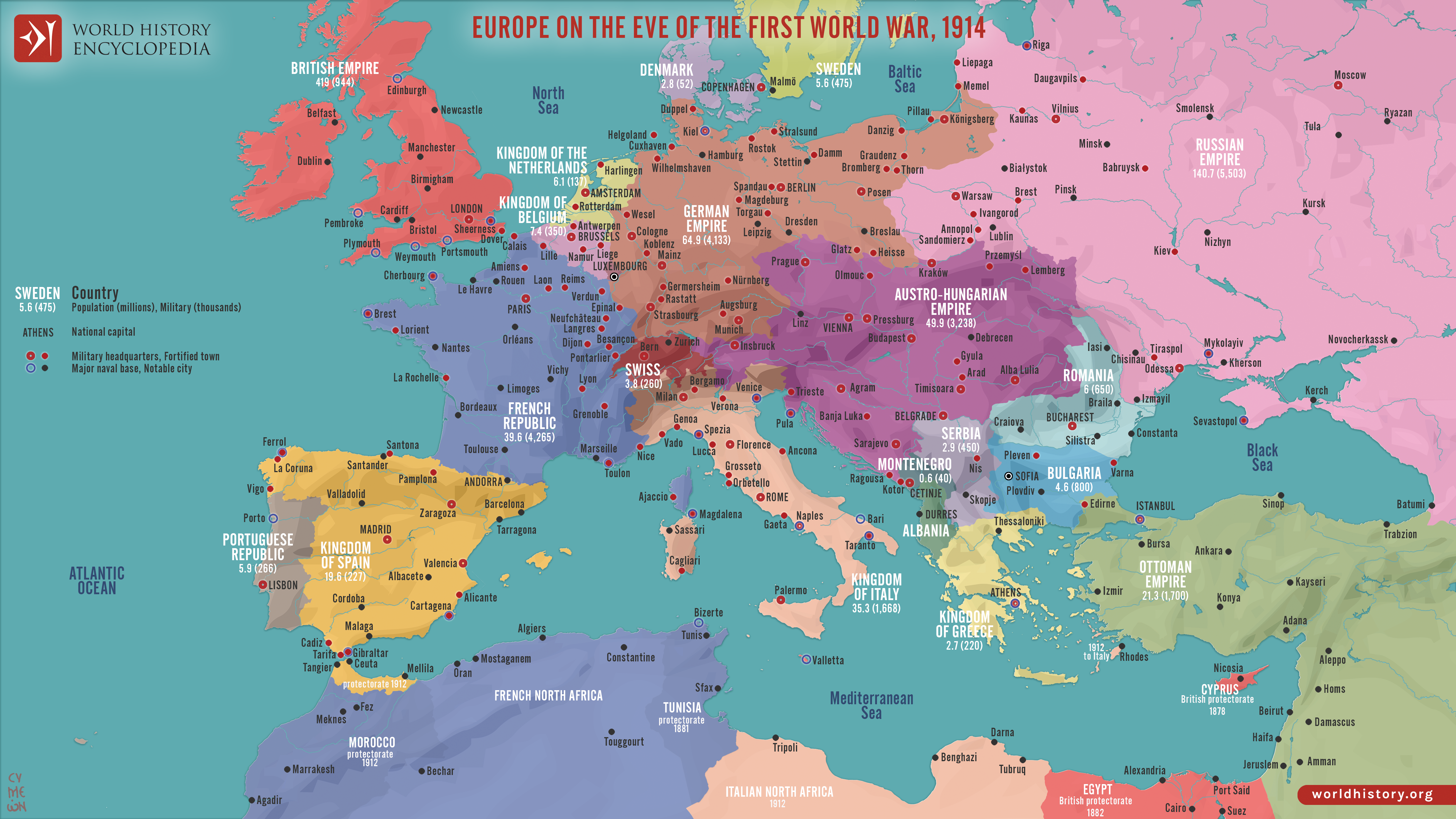
Map of Europe on the Eve of World War I, Early 1914
Europe on the eve of World War I was defined by a volatile mix of alliance politics, imperial rivalry, and rising nationalism. The continent was divided into two heavily armed blocs, the Triple Alliance and the Triple Entente, binding the major powers into rigid commitments that reduced diplomatic flexibility. Long-standing competition between empires, particularly Britain, Germany, Russia, and Austria-Hungary, intensified disputes over colonies, trade, and influence. At the same time, nationalist movements within multi-ethnic empires, especially in the Balkans, pressed for autonomy or independence, undermining imperial stability and turning regional crises into international flashpoints.
This fragile balance was further destabilized by militarism and the arms race that escalated in the decades before 1914. Under leaders such as Wilhelm II of Germany (reigned 1888–1918), Franz Joseph I of Austria-Hungary (reigned 1848–1916), and Nicholas II of Russia (reigned 1894–1917), states expanded conscription, modernized armies, and invested heavily in new technologies, from battleships to heavy artillery. Military planning assumed rapid mobilization and decisive action, making restraint difficult once a crisis erupted. By the summer of 1914, Europe had created a system in which a localized conflict could, and ultimately did, trigger a general war, transforming diplomatic tension into total industrialized conflict on an unprecedented scale.












.png)





.jpg)


 English (US) ·
  French (CA) ·